

Environment
TüRKEY has announced new targets to increase global electricity target from 20 to 35 per cent by 2035.
The proposal is part of Global Climate Action Agenda unveiling ahead of the COP31 Climate conference holding in Antalya, Türkiye, in November.
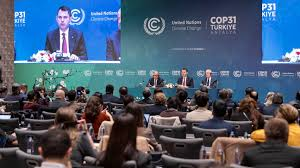
COP31 President-Designate Murat Kurum, who is Türkiye’s Minister of Environment, Urbanisation and Climate Change, made the proposal at the UN June Climate Meetings in Bonn, Germany.
The News Agency of Nigeria (NAN) reports that the meeting is an important step ahead of the Antalya Climate Summit.
“The presidency has proposed a collective global goal to increase the share of final energy demand met by electricity from just over 20 per cent today to 35 per cent by 2035,” Kurum said.
He said that the COP31 presidency was also committed to building a global coalition to implement actions toward achieving the target.
The president-designate also announced other targets, including a goal of halving the growth in global waste by 2035, adding that such ambition was part of COP31’s thematic focus on achieving zero waste.
He said that food waste in particular accounted for 10 per cent of global emissions, primarily through methane, which is 80 times more potent than carbon dioxide as a greenhouse gas.
Kurum also said the presidency had introduced a new global target under its Resilient Cities priority, to reduce energy consumption intensity in the building sector by at least 25 per cent by 2035.
Earlier, the United Nations climate chief, Simon Stiell, called on countries to step up action to implement existing commitments.
He warned that fossil fuel dependency was deepening economic instability and exposing vulnerable communities to worsening climate impacts.
“Tackling the global climate crisis is the hardest, but most important thing humanity has ever tried to do together.
“It is worth doing, because we have no choice. Every economy and population depends on it,” he said.
The Bonn meetings take place annually in the lead-up to COP conferences, the latest of which was held in Belém, Brazil, last November.
Over the next two weeks, delegates will advance technical and political work, as well as review progress on existing commitments.
The mid-year negotiations are being held against a backdrop of intensifying climate impacts and mounting pressures on countries linked to energy security, food systems and economic uncertainty.
Focus will be on issues such as adaptation, finance, the just transition to renewable energy, agriculture and food security.
There will also be a follow-up to the first global stocktake towards achieving the Paris Agreement on climate change, concluded at COP28 in Dubai in December 2023.
Stiell noted that “climate action and the global economy are moving,” although progress remains insufficient.
“We are not where we need to be. But we are somewhere we have never been before,” he said, adding that “this hard work is starting to pay off.”
“People the world over need this process to keep delivering, and at increasing speed and scale,” he said, adding that “we don’t have time to re-open past debates or renegotiate commitments already made.”
He said people who are denied the benefits of climate action are already paying the price, as deadly heat, El Niño impacts and “a fossil fuel cost crisis” sparked by the war in the Middle East impact households and economies worldwide.
Stiell, however, urged countries to “go further, faster” by delivering fully on obligations and plans made under the Paris Agreement, the 2015 treaty that seeks to limit global temperature rise to 1.5°C above pre-industrial levels.
Countries must first streamline the Paris process as “all institutions must continuously evolve and improve,” he said.
He said that they must advance key issues such as the Global Goal on Adaptation, the Belém Adaptation Indicators, delivering the outcomes of the first global stocktake.
According to him, they must also develop the just transition mechanism and finance, including the climate finance programme to the Adaptation Fund.
He further said that they “must bring the work of this process closer to the real economy.”
In this regard, he pointed to the Global Climate Action Agenda as a way to bring together governments, companies, innovators, investors, cities, regions and civil society to support implementation.
Stiell also acknowledged calls by governments to make the UN climate process more efficient and easier to navigate.
He also urged delegates to use the Bonn meeting to address major challenges such as energy security, food security, waste reduction, strengthening the resilience of cities and tackling methane emissions.
“The hard work continues. Make these two weeks count,” he added(NAN)
A.I
June 10, 2026
Tags: Climate Change COP31 Climate conference Global Climate Action Agenda Murat Kurum