

A sense of uncertainty gripped South Africa as workers stayed home, shops closed and buses remained idle while anti-immigrant protests spread across the country.
Many foreign nationals from across Africa also stayed away from work, while thousands had already fled ahead of the June 30 “deadline” set by organisers for all undocumented migrants to leave the country.
The demonstrations got underway on Tuesday after a loose coalition of minor political parties and citizen-led vigilante groups called for undocumented foreign nationals to leave the country.
The campaign has already prompted thousands of migrants to leave their homes amid fears of possible attacks.
In Johannesburg, the country’s commercial hub, and the port city of Durban, groups of protesters, some carrying wooden sticks, gathered as demonstrations got underway.
“People are not working, the jobs are being taken by illegal foreigners. It’s not fair,” said 31-year-old Silindile Xaba, who joined dozens of women chanting anti-migrant slogans in central Durban.
Fearing a repeat of the deadly unrest that rocked the country five years ago, the South African government deployed heavy security across major cities and warned against violence, looting and other criminal activities.
The July 2021 unrest, which claimed about 350 lives, was triggered by the imprisonment of former president Jacob Zuma for refusing to testify before a judicial commission investigating corruption.
Ahead of the protests, President Cyril Ramaphosa announced tougher measures to tackle illegal immigration while urging traditional leaders to help calm tensions and discourage violence.
At least two Mozambicans, an Ethiopian and a Malawian have been killed in anti-immigrant attacks in recent weeks, prompting several African governments to begin evacuating or preparing to repatriate their citizens.
Uganda announced over the weekend that it would begin evacuating nearly 750 of its nationals, while thousands of Malawians and Zimbabweans gathered in Cape Town and Johannesburg on Tuesday awaiting assistance to return home.
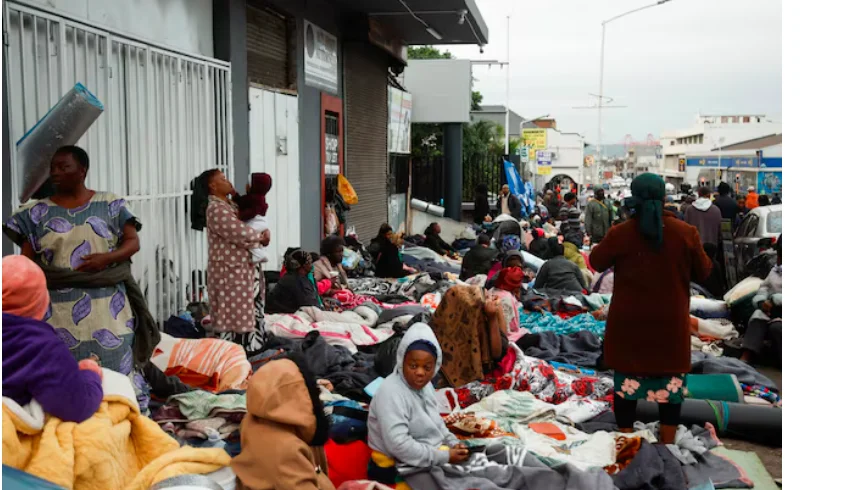
Some migrants said they had been evicted by landlords or dismissed by employers who feared attacks by vigilante groups or possible sanctions from authorities.
“All these people were chased out by their landlords,” said Mabako Majole, a leader of the Congolese community, standing beside about 100 people sleeping on a street in central Durban.
“All these people are legal. They have documents.”
South Africa, one of Africa’s largest economies, remains a major destination for migrant workers despite grappling with an unemployment rate above 30 per cent, high crime and deteriorating public services.
With local government elections scheduled for November, labour analyst Dale McKinley said anti-immigrant sentiments had become politically charged.
“The xenophobic groups have got it wrong,” he told AFP. “This is a problem of governance, corruption and mismanagement.”
Meanwhile, the leader of the anti-immigrant March and March movement, Jacinta Ngobese-Zuma, insisted the campaign was not intended to promote violence.
“We are not calling for violence… No one will be killed on the 30th of June and no looting will take place in our name,” she said, describing the campaign as “a national march to freedom” that would continue until all undocumented foreign nationals were deported.
The demonstrations, held in several cities, were expected to draw thousands of mostly unemployed and low-income South Africans who blame undocumented migrants for the country’s economic hardships.