

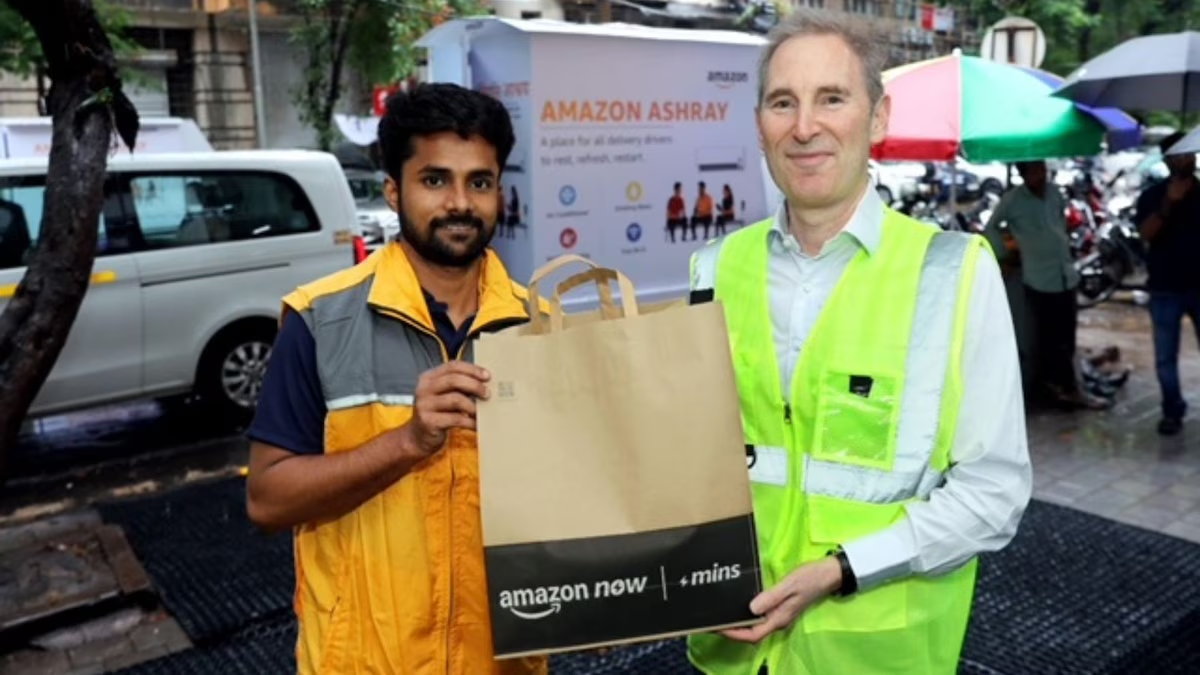
“It’s a magical customer experience,” he told CNBC-TV18 Managing Editor Shereen Bhan after touring one of Amazon’s micro-fulfilment centres that powers the business.
“I made an order that was delivered to me in a little less than 4 minutes,” Jassy said. “I was at one (fulfilment centre), and I had a chance to watch it in motion.”
Amazon first entered India’s quick commerce race with the launch of Amazon Now in Bengaluru in December 2024. It has since expanded to 15 cities, including Delhi-NCR, Mumbai, Pune and Hyderabad.
Now, the company is preparing its biggest quick commerce expansion in the country yet, extending Amazon Now — its own quick commerce business initially built under the codename Tez — to more than 300 cities.
The comments come as Amazon deepens its broader commitment to India. Following Jassy’s meeting with Prime Minister Narendra Modi, the company announced plans to invest $48 billion in India between 2026 and 2030, including an additional $13 billion to expand AI and cloud infrastructure by 2030. The commitment takes Amazon’s cumulative planned investments in India between 2010 and 2030 to more than $88 billion. Amazon has also pledged to support more than 3.8 million jobs and enable $80 billion in cumulative ecommerce exports from India.
Today, the market is dominated by players such as Zepto, Swiggy Instamart and Blinkit, which established an early lead in the segment.
However, Jassy’s enthusiasm, as Amazon Now comes off from its latent energy, is likely not misplaced; data suggests there just might be enough room for Amazon to claim space in the fast-growing industry.
The country’s quick commerce market is on track to become a $50 billion industry by 2030, according to a Google-Deloitte report published in April 2026.
The number of shoppers is expected to double to 70 million, with non-metro or tier-2 cities accounting for 30% of the market.
Finding the right equation
Jassy said Amazon had spent years experimenting with different delivery formats before finding a quick commerce model that worked for customers and made economic sense for the company.
“It took us a little bit of time to find the equation we liked.”
That equation, he said, combines Amazon’s vast product catalogue, ultra-fast delivery and its Prime membership ecosystem, which bundles shopping benefits with streaming and payment services.
The company is now moving quickly to scale the model.
Jassy said the company’s current quick commerce offering, which it started about a year ago, is seeing rapid adoption.
According to him, adoption is doubling every quarter, while Prime members who use Amazon’s quick commerce offering purchase three times more frequently than Prime members who do not.
India as the blueprint
For Amazon, the significance of quick commerce extends beyond India.
“What’s really interesting is that so many of the inventions that have been born here in India, that our team here in India has experimented with and found success with, are being taken to other parts of the world,” he said.
Quick commerce is one of the clearest examples.
Amazon is already “meaningfully experimenting with and expanding” quick commerce in the US and Europe, and Jassy expects the format to eventually become a part of Amazon’s operations across virtually every marketplace where it operates.
“But it started here in India,” Jassy said.
For full interview, watch accompanying video

First Published: Jun 26, 2026 7:30 AM IST