

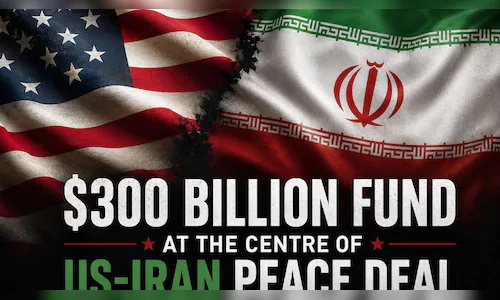
Iran’s state-linked Mehr News Agency highlighted that the US and its allies would pay for what it calls the “reconstruction fund”.
Iran has long called for Israel and the US, which triggered the war by attacking Tehran on February 28, to pay for the damages caused by the war. Iran was then calling it a compensation fund.
The money, if given to Iran, would likely be aimed at restoring damaged infrastructure, supporting industry and reviving Iran’s economy, though its funding sources, governance structure and timeline remain unclear.
Reuters, too, reported that the US and its allies would coordinate a broader economic development plan for Iran, with details to be finalised during a 60-day negotiation period following the signing of the memorandum of understanding. However, it does not specifically mention a dedicated corpus of $300 billion fund.
Separately, Iran claims that the draft 14-point memorandum includes the release of $24 billion in frozen Iranian assets during the 60-day negotiation period, with $12 billion to be made available before talks begin. The document states that “half of this amount must be made available to Iran before the start of the negotiations.”
US President Donald Trump announced on Sunday that the deal with Iran was complete and that commercial ships would flow freely via the Strait of Hormuz, a critical oil shipping route through which roughly 20% of global crude passes. It will now be signed Friday, June 19, in Geneva, Switzerland.
Two days before both sides finalised the agreement, Iranian foreign minister Abbas Araghchi remarked that the best possible agreement is one in which both sides are satisfied to a certain extent, though it may not be an “exact 50-50 split”.
“There is no agreement or deal in which one side is 100% successful while the other gains nothing. This is a basic principle of diplomacy. When you choose the path of negotiation and dialogue, the satisfaction of both parties is of vital importance.”
Also Read: US-Iran War Live Updates: G7 leaders to discuss lasting reopening of Strait of Hormuz, says Macron
(Edited by : Tenzin Norzom)