
‘3.5 Million IDPs Can’t Live On Relief Forever’: UN, EU Push Durable Solutions For Northern Nigeria

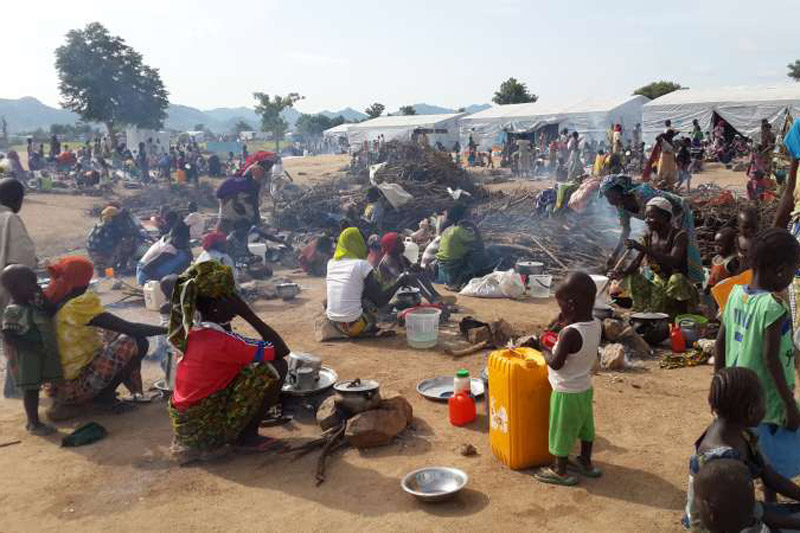
The United Nations, European Union, federal and state governments have called for a decisive shift from emergency humanitarian assistance to long-term development interventions for an estimated 3.5 million internally displaced persons (IDPs) in Northern Nigeria, warning that prolonged dependence on relief aid is unsustainable.
The call was made at the inaugural Project Steering Committee meeting of the “Sustainable Urban Integration of Displaced Populations in Adamawa, Yobe, and Kano States (SIDPIN)” and the “EU Support for Protection, Assistance, and Durable Solutions in Sokoto (SPADS)” programmes held at the UN House in Abuja.
The high-level meeting brought together representatives of government, development partners and humanitarian organisations to review progress, address implementation challenges and strengthen coordination in efforts to provide durable solutions for displaced populations and their host communities.
Speaking at the event, the United Nations Resident and Humanitarian Coordinator in Nigeria, Mohammed Fall, said the scale and duration of displacement in Northern Nigeria demand a new approach that goes beyond humanitarian relief.
“With approximately 3.5 million internally displaced persons in the region covered by IOM Nigeria, displacement is no longer solely a humanitarian issue,” Fall said. “It is a development issue, a peace issue, and a human rights issue.”
He stressed that the international community must move beyond crisis management.
“As the UN Secretary-General has reminded us constantly, we must move from managing crises to solving them, from short-term relief to long-term solutions rooted in dignity and in human rights,” he said.
Highlighting achievements under the UN Common Programme in 2025, Fall disclosed that nearly 200,000 children received education and skills training, about 150,000 people were supported with sustainable livelihood opportunities, while 40,000 individuals regained access to critical legal documentation.
However, he maintained that humanitarian assistance alone cannot resolve the crisis.
“Durable solutions are not achieved by one sector alone. They are built when humanitarian action meets development planning, when government leadership aligns with community voices, and when our collective investments are sustained over time,” he said.
He added: “Durable solutions are not only about ending displacement. They are about beginning the future.”
In what appeared to be a challenge to conventional development programming, the Ambassador and Head of the European Union Delegation to Nigeria and ECOWAS, Gautier Mignot, urged stakeholders to rethink existing intervention models and focus on scalable investments capable of creating lasting impact.
“I personally don’t think that livelihood assistance is part of our mission,” Mignot said.
Calling for a comprehensive review of current interventions, he added: “Let’s review all our livelihood intervention and development projects to see how they can contribute to the purposes of durable solutions.”
The EU envoy argued that while donor-funded programmes had helped stabilise communities affected by conflict and displacement, stakeholders must now embrace more ambitious development strategies.
“When we look at development, we need to have a scale-up attitude in looking at the way we use our funding,” he said. “Let’s scale up ambition on the way forward.”
Representing the Permanent Secretary of the Federal Ministry of Humanitarian Affairs and Poverty Reduction, Mr. Olubunmi Olusanya, described Nigeria’s displacement crisis as a product of multiple pressures, including insecurity, climate-related shocks and socio-economic vulnerabilities.
According to him, the steering committee has a crucial responsibility to provide strategic direction and address implementation bottlenecks, including issues relating to land availability and the localisation of global best practices.
“While humanitarian interventions remain indispensable, experience has shown that durable solutions require a more integrated approach that bridges humanitarian action, development efforts, and peacebuilding initiatives,” he said.
Describing SIDPIN and SPADS as transformative initiatives, Olusanya added: “This project is a modern development project. We embody our collective aspiration for dignity, stability, resilience, and self-reliance for some of the most vulnerable members of our society.”
Participants expressed optimism that the programmes would strengthen governance systems, improve institutional accountability and accelerate efforts to integrate displaced persons into social and economic life in their host communities.
The meeting ended with a consensus that the future of displacement response in Northern Nigeria lies not in prolonged humanitarian assistance, but in durable solutions that offer displaced families a genuine pathway to stability, inclusion and self-reliance.
Michael Olugbode
Follow us on: