
He rescued Trump from one assassination attempt, now has to answer for another

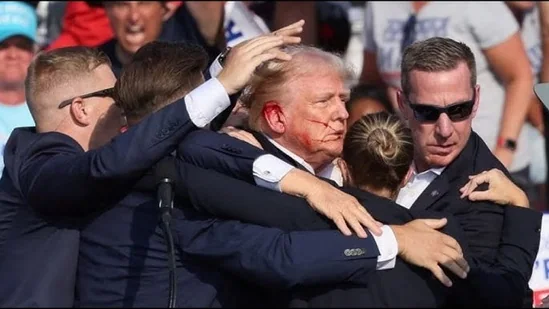
Sean Curran cut the storybook image of a Secret Service agent when, in a dark suit and sunglasses, he whisked Donald Trump away from an attempt on his life in Butler, Pa., in July 2024.
About two years later, another would-be assassin targeted Trump—and Curran is the one answering for the agency as questions about its preparedness mount.
The gunman last month at a Washington press dinner marked the third direct assassination attempt against Trump in less than two years, prompting lawmakers and others to ask whether the Secret Service had sufficiently learned the security lessons from the past attempts. In 2024, Curran was head of Trump’s security detail. Now, he is the head of the entire Secret Service.
A week after the shooting, authorities haven’t yet clearly explained what happened that night. Several videos have compounded the confusion, including one made public Thursday that appeared to show a security dog identifying the suspect, only to have the dog’s handler ignore the warning. Some law-enforcement officials have also privately questioned how the Federal Bureau of Investigation inquiry is being handled and why officials seem to be struggling to provide the public with basic facts, according to people familiar with the concerns.
An FBI representative said the bureau had provided information to the public at “lightning speed.” Appearing on Fox News, Curran said all the evidence he had seen shows that the suspect shot a Secret Service officer with a shotgun before being apprehended.
“Our officer heroically returned fire while being shot point-blank range in the chest with a shotgun and was able to get off five shots,” said Curran, who also went to Capitol Hill to brief members of Congress.
Trump appointed Curran to run the Secret Service last year, choosing a longtime field officer who has spent little time dealing with Washington politics and bureaucracy, but had promised to do anything to protect Trump. He leapfrogged several higher-ranking Secret Service officials to take the job.
The president had developed a strong bond with Curran during the “in-between years,” when Trump was out of power, according to people familiar with the matter. Curran’s brawling with headquarters for more protection at that time was noted and appreciated by Trump. And when an assassin’s bullet grazed his ear in Butler, Pa., the president’s view was cemented, the people said: Curran was one of the few people he could trust in an agency that had failed to protect him.
Last week federal prosecutors charged the 31-year-old suspect, Cole Tomas Allen, with attempted assassination, alleging that he rushed through a Secret Service checkpoint with a shotgun and pistol before being stopped outside the Washington Hilton ballroom.
“There’s always room for improvement, right?” Trump said Thursday in the Oval Office when asked about the Secret Service. “He got into the building.” White House spokesman Davis Ingle said the president continues to have confidence in all of his top law-enforcement personnel, including Curran.
Some former law-enforcement officials said the process functioned as intended given that the gunman didn’t make it into the dinner itself.
“The Secret Service’s layers of protection are meant to act as trip wires to catch people,” said retired Secret Service agent Donald Mihalek. “In this case, it caught somebody—it worked.”
Past independent panels have recommended that the agency appoint a director with significant outside experience, and another former law-enforcement official said Curran might be too loyal to the agency to implement the shake-up that it needs.
So tight is their trust that one White House official recalled talking to the president about an event, and Trump joked that he would attend only if Curran approved of it.
The head of the detail and the protectee always have an intimate relationship, said Ron Layton, a former top Secret Service official. “You’ll see that person more than you see your own family,” Layton said. “Sean really told him, wherever it is, whatever happens, wherever you go, I’ll be there with you.”
Curran joined the Secret Service in 2001. He served as a top agent on Trump’s detail during his first presidential term and took over his protection in 2021.
The role put him in near daily contact with Trump during a postpresidency dominated by court hearings for prosecutions in New York, Washington, Atlanta and South Florida, in between the campaign.
Trump also then faced threats from Iran, and an errant private drone that aides believed could have been from Tehran prompted discussion about pulling him from an event at his golf course in Los Angeles, according to a former Trump aide who was there.
Secret Service officials denied some of Curran’s requests for more resources at the time, including for countersniper measures and ballistic glass at events, the former aide said. Those requests, initially rejected given the limited resources usually provided to former presidents, were granted after Butler, people familiar with the matter said.
As the prospect of prison time for Trump grew increasingly realistic, the Secret Service made preliminary plans for continuing his protection in the event he was detained. In an interview with CBS last year, Curran said he told Trump he was prepared to go behind bars with him.
“Look, if it came to it, I’d be sitting right next to him,” he said. “That’s how much I care for him. That’s how much I felt that he deserved the level of protection that any of our protectees should get. There’s nothing I would have not done for him.”
Curran is respected among agents and known as being “AB,” or “all business,” one person who knows him said.
Though they have developed a personal rapport with the president, Curran and his team must also contend with his temper when informed about restrictions.
In one instance, the Secret Service told Trump that he couldn’t play a hole on a golf course because they deemed it too exposed. The president initially resisted and only relented after one of his agents threatened to drive the armored limousine—a roughly 20,000-pound vehicle known as “The Beast”—right up to the hole, the former aide said. It would have ripped apart the course’s manicured grass.
This past July, the Secret Service said it had implemented or was in the process of acting on several changes recommended by Congress. Among them were improvements to coordination with local law enforcement and the creation of a division devoted to maintaining the Secret Service’s aerial-monitoring capabilities.
In the recent history of the Secret Service, personal relationships with a sitting president have proven reliable propellants up the agency’s ranks. President Joe Biden chose a Secret Service director in 2022 with ties to his family, Kimberly Cheatle, who had grown close to Jill Biden as an agent during Biden’s vice presidency. Cheatle resigned in the weeks after the Butler shooting.
Curran’s to-do list includes not just restoring the agency’s reputation but also preparing for several high-stakes years ahead, as the U.S. barrels toward the midterm elections, this summer’s World Cup and the celebrations planned for the country’s 250th birthday. In 2028, the agency will have to deal with the Summer Olympics in Los Angeles and the presidential election, including two nominating conventions.
The Secret Service has stepped up recruitment in preparation, flying in applicants for three days of interviews and tests in Virginia and Orlando, Fla., to fast-track the hiring process.
When Curran took the job, his background included more time wearing an earpiece than keeping his ear to the ground in Washington’s budgeting and political squabbles. But the early months of his tenure included a windfall for the agency: an infusion of more than $1 billion from what is commonly known as Trump’s “one big, beautiful bill.”
New hiring initiatives have included offering up to $75,000 recruitment bonuses and airing a Super Bowl ad that reportedly cost around $2 million and was made by the action-film director Michael Bay.
The ad featured the iconic photograph of Curran helping a bloodied Trump off the stage in Butler. It also included images from the 1981 assassination attempt on President Ronald Reagan, at the same venue as last month’s press dinner: the Washington Hilton.
Write to C. Ryan Barber at ryan.barber@wsj.com, Annie Linskey at annie.linskey@wsj.com and Maggie Severns at maggie.severns@wsj.com