

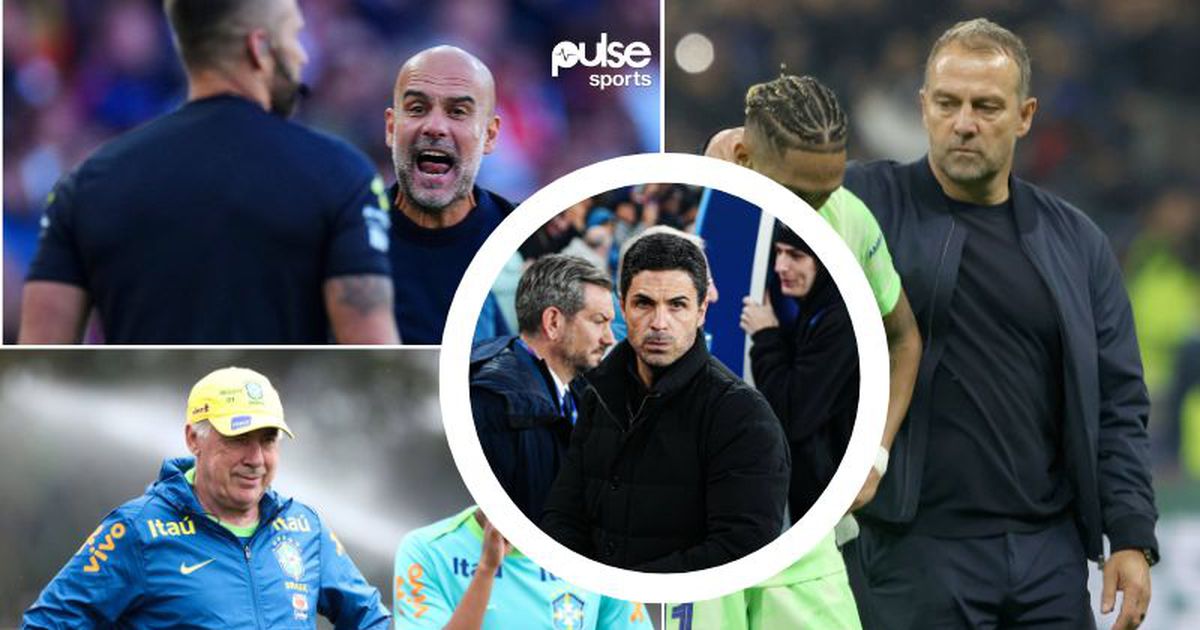
We evaluated everything it takes to be a great manager and crafted a list of the ten best coaches in world football.
Football has always been a game of minds as much as muscle, and in this era, the men on the touchline shape what we watch as much as the players on the pitch.
The modern manager must combine tactical innovation, man-management, psychological mastery, and the capacity to thrive under suffocating pressure.
This article ranks the ten best football managers in 2026, blending metrics such as trophies won, tactical innovation, consistency, club stature, player development, adaptability, legacy, and win percentage.
Only active managers, or those who have held a major role within the last three years, are considered. These are the coaches defining world football right now:
10. Simone Inzaghi (Al Hilal, Italy)
Simone Inzaghi is the modern master of the 3-5-2 system. Domestically, he secured the Serie A title in the 2023/24 season, alongside a pair of Coppa Italia victories (2021/22, 2022/23) and a trio of Supercoppa Italiana trophies (2021, 2022, 2023).
However, Inzaghi’s high placement here is validated by his immense European knockout pedigree, achieved on a shoestring budget.
Simone Inzaghi guided Inter into the Champions League knockouts for the first time in a decade
He successfully navigated Inter Milan to two Champions League finals in three years (the narrow defeat to Man City in 2022/23 and the 2024/25 final).
His teams are exceptionally difficult to break down, utilising highly synchronised midfield rotations that maximise the output of veteran players. He is currently managing Al Hilal where he has a 70% win rate.
9. Arne Slot (Liverpool)
Replacing a legend is usually a poisoned chalice, but Arne Slot’s 2024/25 Premier League title with Liverpool defied that narrative. His courageous, front-foot pressing style and vertical attacking movements revived Liverpool’s identity while introducing tactical clarity and structure.
&format=webp)
While Liverpool have shown a sharp decline this season, the Reds’ hierarchy are confident in backing Slot, and their decision is understandable. Slot is a winning force, winning an Eredivisie title with Feyenoord before ending Pep Guardiola’s four-year hegemony in the Premier League.
8. Vincent Kompany (Bayern Munich)
When Bayern Munich appointed Vincent Kompany in 2024, many doubted the idea of handing Europe’s biggest job to a coach coming off a relegation with Burnley.
Yet, two Bundesliga titles and a Champions League semi-final in 2026 have turned sceptics into believers. His sharp, ball-dominant tactics mirror Pep Guardiola’s influence but add direct vertical transitions associated with German football.
&format=webp)
Kompany at Bayern Munich. (Photo Credit: Bayern/X)
Kompany has created the most devastating attacking force in Europe, with his team breaking a 54-year scoring record. They have scored 116 goals this season, 15 more than the next-best scoring team in Bundesliga history.
7. Xabi Alonso (unattached)
Though unemployed as of early 2026, Xabi Alonso’s influence on the modern game remains seismic. His 2023/24 unbeaten Bundesliga triumph with Bayer Leverkusen, their first-ever league title, transformed him from a promising coach into one of Europe’s elite.
His tactical identity, blending positional play with counter-pressing fluency, has set him apart as a leading figure in a new coaching generation.
&format=webp)
Alonso’s brief Real Madrid stint in 2025 ended prematurely, but not before showing glimpses of what could be possible. However, he needs to show he can manage big egos after struggling to bring the Real Madrid dressing room under his control.
6. Mikel Arteta (Arsenal)
Mikel Arteta is one of the most paradoxical managers on this list. His win rate of 59.9% as Arsenal manager is the best in the club’s entire history, better than Herbert Chapman, better than Arsène Wenger, better than every manager who came before him.
He has reached 208 wins in just 347 matches, an extraordinary pace. He has rebuilt Arsenal from an underachieving ‘banter club’ into a serial top-two side in the most competitive league in the world, finishing second in the Premier League in three consecutive seasons.
&format=webp)
He took them to consecutive Champions League semi-finals: 2024/25 saw them eliminate Real Madrid in the quarter-finals, their first semi-final since 2008/09, and they are set to make their first final appearance since 2006.
And yet, the trophies. An FA Cup in his debut season, beating Chelsea 2–1 in the final on 1 August 2020, and two Community Shields. That is the full list of silverware over six years. For a manager of this quality, operating at a club of Arsenal’s size, spending and ambition, the absence of a Premier League title or a Champions League is, by now, significant.
He is the only manager on this list without a league title to his name; that fact sits at the edge of every conversation about whether Arteta truly belongs at the summit.
5. Antonio Conte (Napoli, Italy)
Antonio Conte proved once again his ability to deliver league titles, returning a broken Napoli to the summit of Italian football.After their Scudetto drought-breaking run under Spalletti, Napoli had the worst title defence in the league’s history. Conte arrived in 2024 and immediately delivered a league title and has retained their contender status this campaign.
&format=webp)
A serial winner with six league titles across two countries (Italy and England), Conte’s football fuses a disciplined structure, physical intensity, mental toughness and precise offensive play.
4. Hansi Flick (Barcelona)
From Bayern Munich’s treble-winning tactician (2020) to Barcelona’s stabilising architect, Hansi Flick’s legacy spans two modern football dynasties.
After taking charge at Camp Nou, Flick guided Barça to the domestic treble in the 2024/25 season, and he is set to secure consecutive league titles for the Blaugrana for the first time since the 2017/18 and 2018/19 seasons.
&format=webp)
He also has a successful signature system, aggressive pressing with ultra-verticality, which reawakened Barcelona culturally after a succession of managers that failed to combine on-pitch success with a possession-dominant playing style.
Across domestic and European games for Barcelona, Flick’s win rate is 75.89%. He has also won every major trophy at club level, including a sensational treble at Bayern Munich.
3. Luis Enrique (Paris Saint-Germain)
Luis Enrique finally did what no one else could: transform PSG’s talent into a cohesive machine. The 2025 Champions League triumph, part of a sensational sextuple-winning campaign (Ligue 1, Coupe de France, Trophée des Champions, Champions League, Club World Cup, and UEFA Super Cup), certified him as the first PSG manager to fulfil Qatar’s European dream.
&format=webp)
Luis Enrique’s PSG stole a win against Bayern Munich at home.
A disciple of positional play, Enrique restructured PSG’s identity without relying on megastars, instead prioritising systems and synergy.
With an incredible win rate at PSG and prior success with Spain and Barcelona, he has proven versatility across environments. Few in history manage both aesthetics and silverware so sustainably.
2. Carlo Ancelotti (Brazil)
There is one man who has won five Champions League titles. There is one man who has won league titles in all five of Europe’s major leagues: Serie A, Ligue 1, the Premier League, LALIGA, and the Bundesliga.
There is one man who has been the most successful manager in the history of the most successful club in European football (Real Madrid, where he won 15 trophies across two spells). That man is Carlo Ancelotti, and right now, aged 66, he is managing Brazil ahead of the 2026 World Cup, an appointment that could, if it goes as planned, add the one piece of silverware no manager in history has won: a World Cup with a non-native country.
&format=webp)
Ancelotti defies the modern obsession with rigid tactical dogma. He is the king of fluid pragmatism. He remains the ultimate big-game coach.
No one on earth is better at managing the dressing room of a super-club, finding harmony among generational egos, and making in-game tweaks that win finals. He is football royalty who simply refuses to decline.
1. Pep Guardiola (Manchester City)
Still the benchmark. Even as Manchester City’s domestic stranglehold shows faint cracks, Pep Guardiola’s cumulative influence remains unmatched.
With six Premier League titles in nine years, two FA Cups, four League Cups, and three Champions League trophies (one with City, two with Barcelona), Guardiola continues to redefine the tactical grammar of football.
&format=webp)
Man City manager Pep Guardiola | Imago
In addition to being the winningest manager in the game currently, Pep’s innovations and preferred playing style remain the global blueprint.
His career win rate of 70.88%, according to Footystats, spread across Barcelona, Bayern, and City, attests to sustained supremacy.
Guardiola is undoubtedly the best current manager and, for many, in the history of the sport. His success in shaping football’s evolution since making his debut in 2008 and mentoring many of the game’s current brilliant minds makes him a football ecosystem in itse