

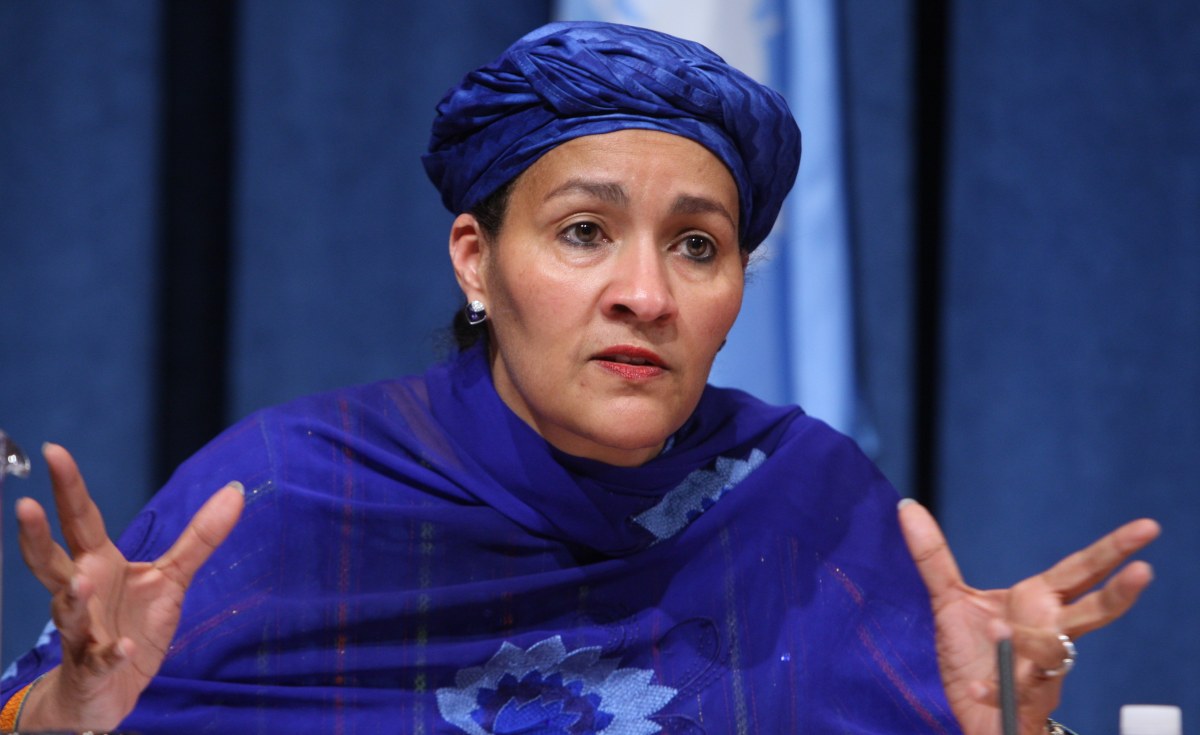
The Deputy Secretary-Common of the United Nations, Amina Mohammed, has underscored the strategic significance of Dangote Industries Restricted, notably the Dangote Fertiliser Restricted—in addressing Africa’s mounting meals safety challenges, whereas calling for stronger world partnerships to scale its influence.
Talking throughout a go to to the corporate’s industrial complicated at Ibeju-Lekki, Lagos, Mohammed stated the United Nations would prioritise amplifying scalable options able to mitigating the continent’s meals disaster, describing Dangote’s built-in industrial mannequin as a vital pathway.
“I feel the UN’s job right here is to amplify and to place visibility on the probabilities of mitigating a meals safety disaster, and that is considered one of them,” Mohammed was quoted to have stated n an announcement by Dangote Group.
“I hope that after we return, we will proceed to interact companions and international locations that ought to collaborate with Dangote Industries,” she added.
Her remarks come at a time of heightened concern over meals shortages and provide chain disruptions throughout Africa, pushed by world {economic} pressures, climate-related shocks and geopolitical tensions, notably within the Center East.
In his remarks, President/Chief Government of Dangote Industries Restricted, Aliko Dangote, stated the group has ramped up exports of urea and Premium Motor Spirit (PMS) to African markets affected by provide disruptions arising from the disaster.
Noting the widening influence of the state of affairs throughout the continent, Dangote stated the corporate has intensified shipments of fertiliser to assist agricultural productiveness and ease provide constraints.
“The challenges are many. One is of urea, which is fertiliser that now we have. I feel within the final couple of days we’ve been loading to largely African international locations, which we weren’t doing earlier than.
“After which now it’s to do with petroleum merchandise, which we are actually sending primarily to African international locations”, Dangote stated.
He added that the refinery has shipped about 17 cargoes of petrol to African international locations to cushion the influence of the disaster, leveraging its 650,000 barrels per day capability to stabilise provide throughout a number of areas.
“What I can do is guarantee Nigerians … and most of West Africa, Central Africa, and East Africa, now we have the capability to provide them,” Dangote stated.
On feedstock provide, Dangote counseled the Nigerian Nationwide Petroleum Firm Restricted (NNPC) for rising crude deliveries to the refinery in March, noting that volumes rose to 10 cargoes—six provided in naira and 4 in {dollars}—to assist home gasoline availability.
“Final month, they gave us six cargoes for naira and 4 cargoes for {dollars},” he stated.
Regardless of the development, the corporate stated the provision stays under the 19 cargoes required for optimum operations, with the refinery persevering with to bridge the hole via imports from the USA and different African producers.
Dangote additionally expressed concern over the unwillingness by worldwide oil firms working in Nigeria to promote to the refinery, stating that their desire for promoting crude to merchants forces it to repurchase at increased prices, with broader implications for the economic system.
Dangote added that the refinery is looking for elevated entry to domestically priced crude underneath native forex preparations as a part of efforts to reasonable gasoline prices and improve long-term vitality and meals safety throughout the continent.
Peter Uzoho
Times Nigeria