

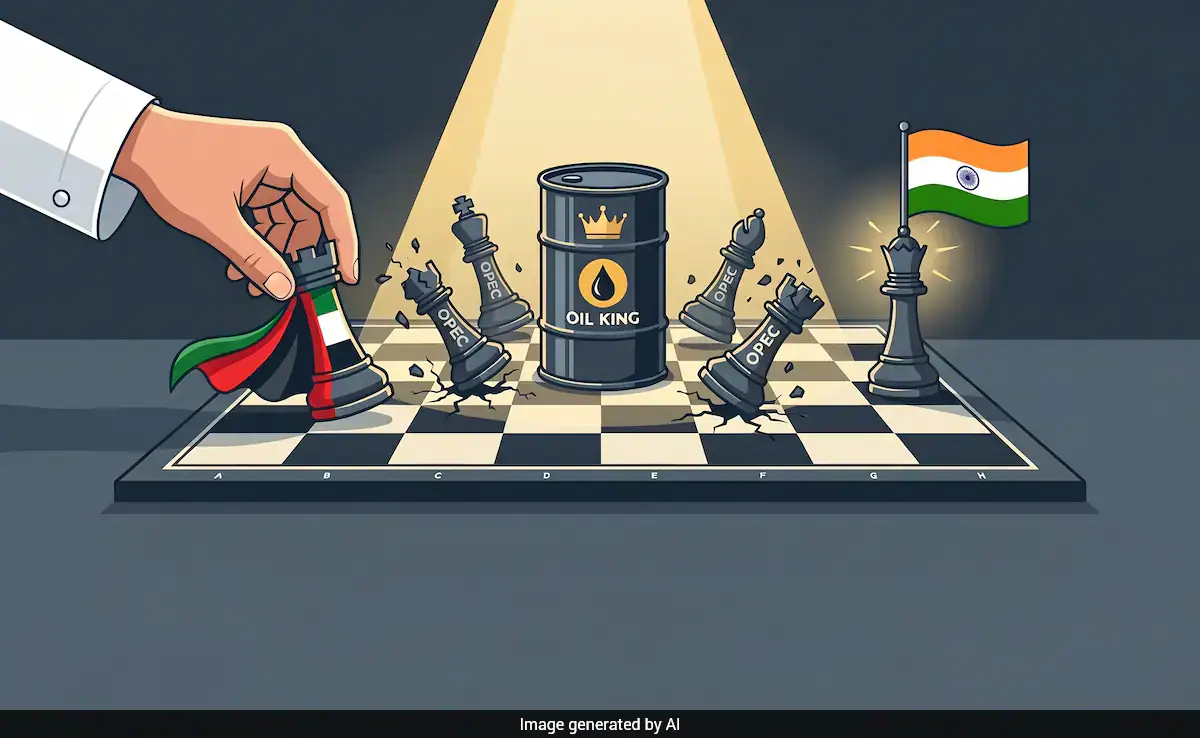
The United Arab Emirates will leave OPEC and OPEC+ – the world’s largest oil-producing blocs, which control roughly 40-50 per cent of global output and influence prices through production quotas – from May 1, the country’s state-run WAM news agency said Tuesday.
This signals likely significant shifts in oil prices – rather than production levels – immediately after the UAE’s exit. India is among the countries looking to benefit, particularly with New Delhi looking to diversify import sources to offset uncertainty in the Middle East.
. – Scroll to continue
From an overall perspective, the UAE’s move has immediate and extended consequences for energy markets and countries that are a net importer of oil and gas, such as India.
Why UAE quit OPEC, OPEC+
Abu Dhabi announced its exit against turmoil in the global energy trade brought on by the US and Israel’s war on Iran; fighting that began February 28 spread quickly to Gulf countries as oil and gas fields, refineries, and depots, were targeted.
UAE energy sites were hit – despite American air defence cover – by Iran, including the Ruwais refinery that can process 922,000 barrels of crude daily, the Fujairah Port that is a critical export terminal, and the Habshan gas fields that are one of the region’s biggest.
Its oil exports were further squeezed after Iran locked down the Strait of Hormuz – a critical waterway that ships up to 25 per cent of the world’s oil – and prices spiked to their highest levels since the start of Russia’s war on Ukraine in February 2022.
The UAE has said stepping back from these blocs reflects its “evolving energy profile” and expansion of production, while maintaining a “responsible and reliable role” in global markets.
Behind the remark there is potential for significant shifts in oil supply and prices.
Short-term pain, long-term gain?
What it also signals, at least in the short term, are fractures within the Organization of the Petroleum Exporting Countries and the wider ‘+’ bloc that will likely unsettle markets.
But the long-term impact for India and the rest of the world is seen as positive because quitting the groups will give the UAE flexibility to increase production outside of OPEC quotas.
That could lead to more supply and lower prices and that will benefit large-scale importers like India, which buys around 85 per cent of its estimated 5.8 million barrels daily consumption.
“The exit of the UAE from OPEC is likely to increase global oil supply flexibility in the medium term… which could soften crude prices. It is likely to be beneficial for India’s import bill and inflation in that sense,” Grant Thornton Bharat’s Sourav Mitra, Partner (Oil & Gas), told the Financial Express.
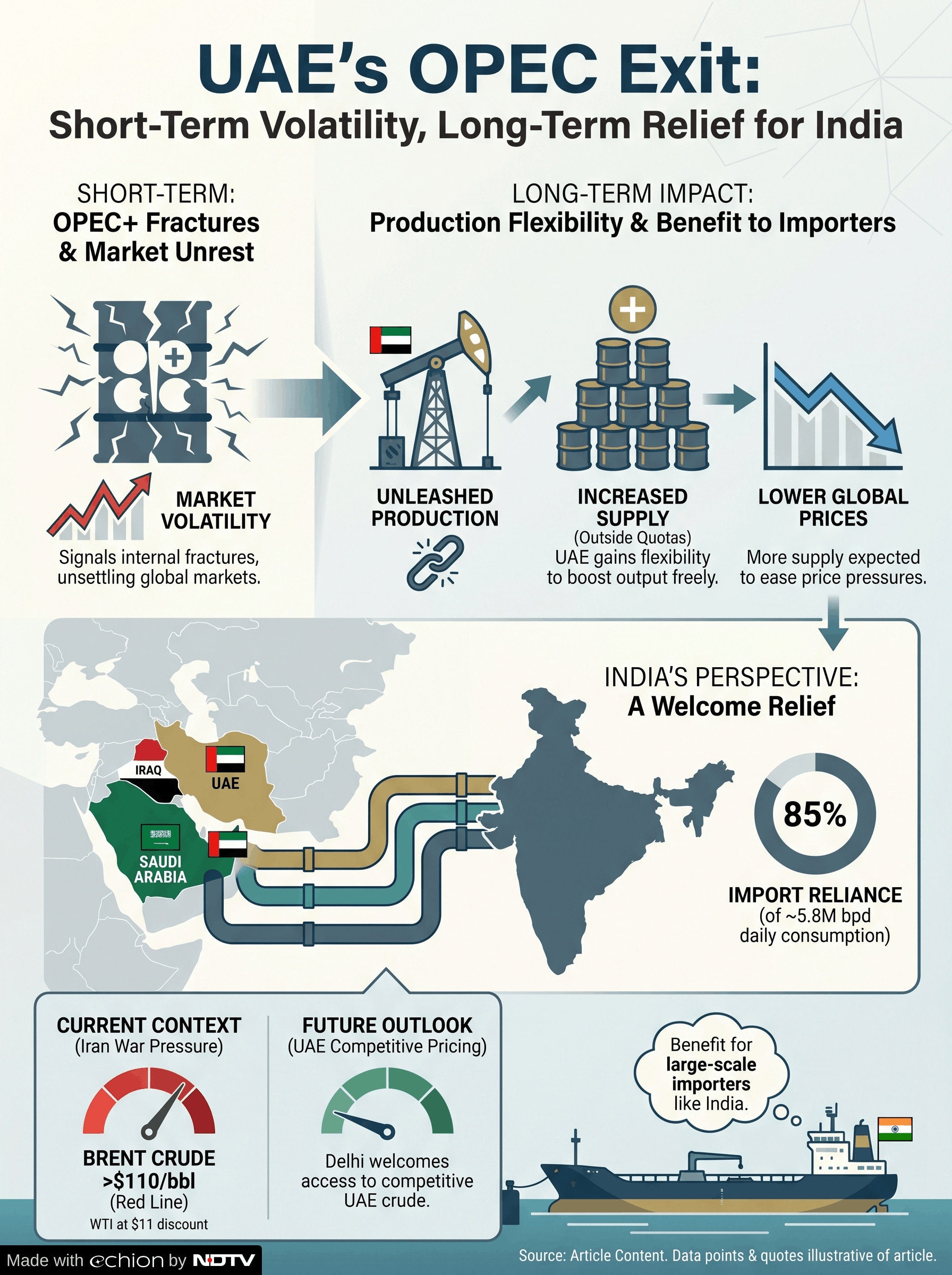
And a majority of that daily requirement is sourced from the Middle East. The UAE, Saudi Arabia, and Iraq are among the top five in a list currently headed by Russia and rounded off by the US.
India bought an estimated 620,000 per day from the UAE in April 2026.
At present, oil prices have been driven upwards by the Iran war; global benchmark Brent crude crossed the $110 per barrel red line, while West Texas Intermediate was at an $11 discount.
Delhi will welcome being able to purchase UAE crude at more competitive prices.
The freight risk angle
The war and double blockade across the Strait of Hormuz has spooked the shipping industry; insurance and charter rates have increased dramatically and Iran’s demand for a toll – up to $2 million per tanker – has only added to potential costs.
Being able to deal with the UAE as a separate seller should give Indian refineries the chance to re-adjust risk levels and pricing, particularly if some volume of crude is routed via overland pipelines to the country’s Fujairah Port on the Gulf of Oman coast to bypass the blockade.
Realistically, India’s concern was less about volume than prices. The country has a relatively diverse basket that was increased to 41, the government said, after the Iran war began.
That said, if the UAE chooses to export beyond the OPEC quota – to which it will not be bound from May 1 – this can only be good news for Indian consumers as it will soften prices.
NDTV Special | Saudi-Pakistan Factor Behind UAE’s OPEC Exit
But that will likely link to how much the UAE is willing to step out of OPEC’s long shadow and the balancing act Abu Dhabi must perform in boosting production and exports while maintaining ties with Gulf neighbours who are now rivals in this market.