

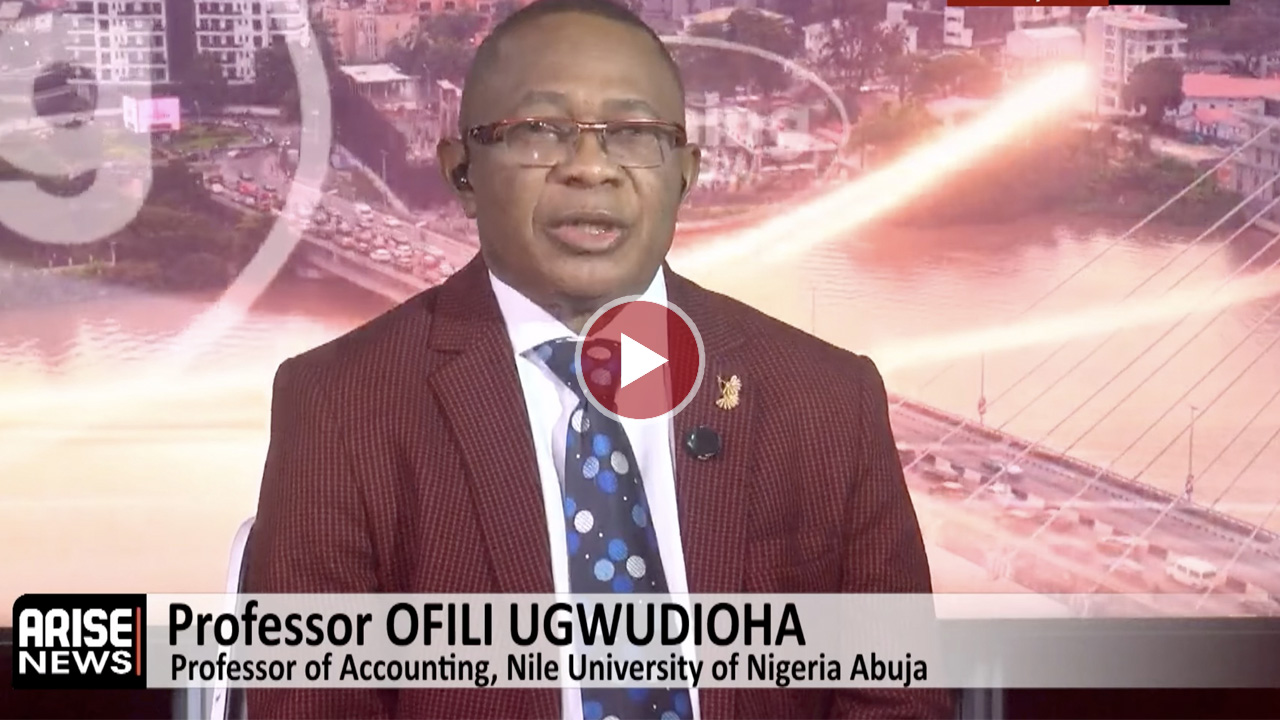
Professor Ofili Ugwudioha, a Professor of Accounting at Nile College of Nigeria, Abuja, has criticised Nigeria’s budgeting framework, describing it as outdated and chargeable for the nation’s persistent deficit challenges.
Talking in an interview on ARISE Information on Sunday, Ugwudioha mentioned Nigeria’s reliance on an previous budgeting mannequin continues to undermine fiscal sustainability and environment friendly public spending.
“Such a budgeting system could be very archaic, could be very previous, is the kind of budgeting system that was in vogue round 100 years in the past,” he mentioned.
He defined that the present incremental budgeting strategy, the place new budgets are constructed on earlier figures with share will increase, contributes considerably to rising deficits and weak {financial} planning.
Highlighting figures from the 2026 funds, Ugwudioha famous that projected income falls far under deliberate expenditure.
“I noticed that we’re incomes round, or we’re going to earn round 34 trillion. That threw us right into a deficit funds of 24 trillion,” he mentioned.
“When you have a look at these two, you see that we’re incomes 34 and we’re spending 68, which implies our deficit is 24.”
He described the deficit stage as extreme and unsustainable.
“That is too excessive,” he mentioned.
“I at all times say that deficit budgeting can’t be greater than 20 to 25 p.c, in order that it is possible for you to to repay.”
The professor, nonetheless, acknowledged a constructive shift within the construction of the 2026 funds, notably the rise in capital expenditure.
“From my very own evaluation, the federal government has executed effectively by growing the capital facet of the funds to virtually 50 p.c,” he mentioned.
“It’s far, much better than what was taking place, as a result of up to now it was 30 p.c for capital and 70 p.c for the present.”
He added that capital expenditure performs a vital position in nationwide growth, protecting infrastructure, training, well being, and safety.
Regardless of this enchancment, Ugwudioha careworn that structural points in funds implementation proceed to hinder outcomes.
“The issue now we have in our budgeting system is that there isn’t any sturdy funds analysis and monitoring unit,” he mentioned.
“It’s due to the shortage of this institutional analysis and monitoring unit that you just see quite a lot of deserted initiatives right here and there.”
He argued that the absence of unbiased oversight results in waste, inefficiency, and repeated allocation of funds to initiatives that stay uncompleted.
“You can’t consider your self as a result of you’re the one who did the job,” he mentioned.
“There should be an unbiased physique that can consider what you could have executed and provides report back to authorities.”
Ugwudioha additionally criticised the extension of the 2025 capital funds into 2026, describing it as a violation of fiscal self-discipline.
“Price range is supposed for 12 months, January to December,” he mentioned.
“The funds ought to run inside that interval.”
“And something that continues to be there that isn’t executed till thirty first December ought to be stopped.”
On exterior pressures, together with the influence of worldwide tensions such because the US-Iran battle, he warned that Nigeria stays weak as a consequence of weak {economic} constructions.
“It’s really weak, however there may be additionally a technique to cowl it if we are literally doing what we should always do as a authorities,” he mentioned.
He additional criticised financial coverage, notably excessive rates of interest, which he mentioned discourage funding and {economic} development.
“Rising NPR when that enhance in NPR will discourage funding,” he mentioned.
Ugwudioha additionally pointed to structural weaknesses in Nigeria’s oil and refining sector, noting that reliance on exterior elements continues to reveal the economic system to shocks.
“It’s tough for presidency to ensure Dangote scale back the worth of your product,” he mentioned.
He concluded by urging the federal government to prioritise insurance policies that help productiveness slightly than short-term reduction measures.
“Don’t give cash. Give one thing that can allow Nigerians to work,” he mentioned.
“Nigerians aren’t lazy. They will produce.”
Faridah Abdulkadiri
Times Nigeria