

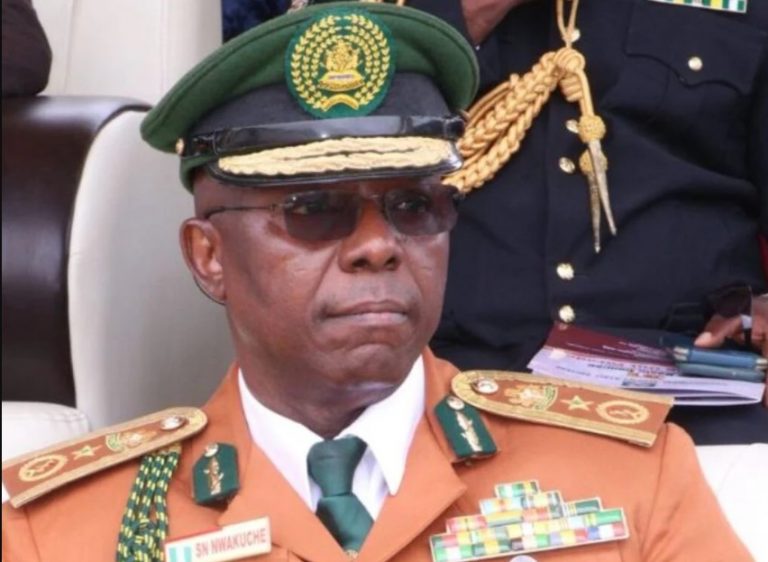

One year ago, when Sylvester Ndidi Nwakuche, MFR, mni, took the oath of office as the substantive Controller General of Corrections (CGC), the narrative of correctional service in Nigeria was one of despair. The image was unyielding with ancient walls weeping with decay, roofs that sang in the rain and a public consciousness that had long consigned its correctional facilities to the realm of forgotten dungeons.
The Service was a shadow that was feared and disrespected; spoken of only in the breath of jailbreaks and congestion, never in the language of reform or dignity. Today, exactly one year later, that narrative lies in the dust. In its place rises a new architecture, not just of concrete and steel, but of trust, transparency and audacious hope. To speak of the Controller General of Corrections’ first year is to speak of a renaissance. It is to speak of a man who looked upon the dry bones of a broken system and commanded them to rise.
The most visceral evidence of the Nwakuche revolution is written in mortar and marble. For decades, the Nigerian Correctional Service (NCoS) operated from structures that insulted the very idea of rehabilitation.
The headquarters itself, an edifice that should have symbolised authority, had become a tired mausoleum of leaking ceilings, faded paint and broken furniture. Morale does not reside in dilapidation. But in the last 12 months, that has changed. The controller-general launched an aggressive infrastructural renaissance that has swept across the federation.
Today, the national headquarters in Abuja gleams. Its corridors now echo with the confident footsteps of officers who finally feel seen. The facelift is not cosmetic; it is philosophical. A command centre that looks like a palace tells officers and inmates alike that the state takes its duty of corrections seriously.
Beyond Abuja, the wave has spread.
Across the six geopolitical zones, over 20 major facilities have seen either total renovation or critical rehabilitation with new roofs, modern plumbing, fortified perimeters and humane cell blocks. This is not a facelift. This is a resurrection. For the first time in decades, an inmate in a custodial centre can sleep without rain on his face. For the first time, a correctional officer reports to work not to a ruin, but to a fortress of rehabilitation and reformation.
But bricks and mortar are only half the story. The real measure of a leader is the steel of his ideas. In March this year, the Ministry of Interior convened its annual performance retreat, a gathering of the country’s most quintessential internal security minds. It was there, before an audience of the Minister of Interior, Dr. Olubunmi Tunji-Ojo, top brass of the ministry and its agencies, that the controller-general delivered what witnesses now call “the presentation that silenced a room.”
For 45 minutes or so, the controller-general did not read from a script. He preached from a vision. With data streaming from projectors and passion flooding from his voice, he laid bare the roadmap that has since become the bible of modern corrections in Nigeria. He spoke of decongestion not as a slogan but as a matrix, showing how the Service under his watch, had already processed over 12,000 cases through non-custodial alternatives amongst several other results. He unveiled a digitisation plan that will link every custodial centre to a central command hub before the end of 2026. That retreat was a coronation of competence. And the crown now rests firmly on Nwakuche’s head.
Perhaps the most profound revolution, however, is invisible to the naked eye. It is a revolution of the heart. For generations, custodial centres were sealed fortresses of secrecy. Society did not know what happened behind those walls, and frankly, society did not care.
The incarcerated were the invisible, the forgotten and the damned. The system rotted in darkness because no one was watching. CGC Nwakuche has shattered that darkness with a radical weapon: an open door policy. From his first week in office, he made a declaration that sent tremors through the old guard: “The gate of correctional centre is not a wall of silence. It is a door. And I am turning the handle for everyone who has a stake in justice.” And turn the handle he did.
The CGC has systematically carried along every relevant stakeholder through briefings, visits, town halls and strategic partnerships. Civil society organisations are now partners in progress, while journalists have been given unprecedented access to correctional centres. Lawyers, human rights activists, traditional rulers and religious leaders have all been brought into the circle of trust.
The result has been transformational. For the first time, the Nigerian public is beginning to see correctional centres not as black holes, but as institutions in transition. The veil of ignorance has been lifted. And with visibility has come accountability.
The most stunning testament to this open-door philosophy occurred just three days ago, in what will surely be recorded as a watershed moment in the annals of Nigerian security. For the first time in the history of the Service, an Inspector General of Police (IGP) paid an official visit to the controller general of corrections not to summon, not to direct, but to seek collaboration. Let that sink in.
The Nigeria Police Force (NPF) came to the Correctional Service not as a superior, but as a partner. The IGP, accompanied by a retinue of senior officers, sat with CGC Nwakuche for hours to discuss how to jointly tackle the rising tide of insecurity, from banditry to kidnapping to urban crime.
What made this possible? Competence, friendliness and respect. The IGP did not come because of a memo. He came because the word on the street, and in the corridors of power, is that Sylvester Nwakuche knows what he is doing. He has built a Service that is no longer a liability but an asset. His custodial centres are no longer weak links in the security chain; they are nodes of intelligence, discipline and strategic cooperation.
That meeting birthed a joint task force on intelligence sharing, focused on preventing external aggression on custodial facilities and using inmate intelligence to crack open cold cases. The walls between security agencies are crumbling, and Sylvester Nwakuche is the mason.
But what happens when the goodwill of the public is not just a theory but a living, breathing shield? The answer came on a tense night in Kuje, Abuja recently, a name that once echoed with the horror of a jailbreak. In the old days, the community around the Medium Security Custodial Centre (MSCC), Kuje, kept its distance. Fear and indifference were the watchwords. Information never flowed. When trouble came, the facility stood alone. Not anymore.
Thanks to the relentless community engagement strategy of CGC Nwakuche, through dialogues, outreaches and community rapport, the people of Kuje now see the Correctional Service as a neighbor, not an enemy.
So when intelligence emerged recently of a planned external aggression on the Kuje facility, it was not the security cameras that first raised the alarm. The community, working in seamless synergy with correctional officers, mounted vigilance that would make a military division proud. Suspicious movements were reported within minutes.
The attack never materialised, not because the plotters lost courage, but because they found no gap. They found a wall of people who had been won over by a controller-general who believed that security is not a fortress, but a family. In Kuje, a new doctrine was born: the public as sentinel. And it was born from trust.
The cumulative effect of these interventions, especially in infrastructure, transparency, collaboration, and community partnership, has been something the Service has not known in a generation: genuine public goodwill.
The Nigerian Correctional Service is no longer the butt of jokes on social media. It is no longer the symbol of state failure. It is, instead, a quiet success story. It is now common to see citizens volunteering information to correctional authorities.
Civil society organizations that once only criticized now offer technical support. Even the international community has taken notice. This is the Nwakuche effect. He has not merely managed a Service; he has rebranded an entire sector of the criminal justice system. He has shown that corrections can be humane without being weak, and firm without being cruel.
For every great beginning carries within it the seeds of a possible end. The progress of the last twelve months is real, but it is also fragile. Infrastructural renaissance requires sustained funding. The open door policy requires a culture change that must be institutionalized beyond one man’s tenure. The public goodwill, once won, must be fed with continuous transparency and trust-building.
Therefore, this is a call to the government, the National Assembly, the judiciary, and to the Nigerian people: do not abandon the Correctional Service. Give CGC Nwakuche the tools to finish what he has started. Protect his reform agenda from bureaucratic sabotage. And when the time comes, ensure that his successor inherits not a broken system repaired, but a repaired system that is unbreakable.
As for the controller general himself, he would not ask for praise. He is a man of quiet action and a technocrat with the soul of a poet. But the nation owes him a debt. He took a Service that was a beleaguered and began to turn it into a national pride.
A year ago, the custodial centre was a heavy, rusted and closed gate. Behind it, was darkness, and before it, was ignorance. Today, thanks to Sylvester Ndidi Nwakuche, that gate has become a door. It opens to light. It opens to partnership. It opens to hope. And beyond that door, a new Nigeria is being built.