

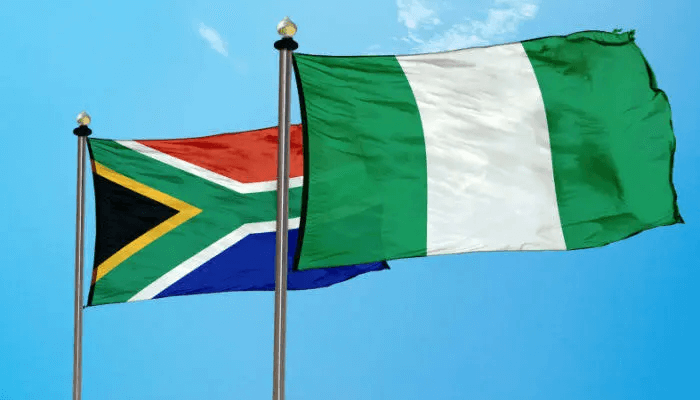
The 2025 {economic} relationship between South Africa and Nigeria has emerged as considered one of Africa’s most strategically vital partnerships, with bilateral commerce topping $2.16 billion regardless of a headline commerce deficit for the Southern African nation.
New information launched on the finish of the 4th version of the South Africa Week held in Lagos, confirmed the nation exported $468.48 million price of products and companies to Nigeria final 12 months, whereas importing $1.69 billion — leaving a $1.22 billion deficit.
The occasion hosted by the South African Consulate Basic in Lagos, in partnership with Model South Africa and the Improvement {Bank} of Southern Africa (DBSA) is as a strategic initiative aimed toward fostering social cohesion between South Africans and Nigerians whereas positioning South Africa as a most well-liked vacation spot for enterprise, tourism, and schooling.
“The 2025 {economic} relationship between South Africa and Nigeria displays a strategically vital, multi-dimensional partnership anchored in commerce, vitality safety, funding flows, and powerful institutional cooperation.
“Whereas bilateral commerce stays structurally imbalanced – with South Africa exporting US$468.48 million and importing US$1.69 billion, leading to a US$1.22 billion deficit – this dynamic is basically pushed by South Africa’s reliance on Nigerian crude oil, positioning the connection as considered one of strategic interdependence relatively than imbalance alone.
“This partnership is additional elevated by the relative {economic} weight of each nations”, a press release by the organisers said.
In keeping with the Worldwide Financial Fund (IMF) projections, South Africa’s financial system is valued at roughly $443.6 billion, whereas Nigeria’s stands at round $334.3 billion in nominal phrases for 2026.
As two of the biggest economies on the continent, their bilateral engagement constitutes a central axis of African {economic} exercise, with disproportionate affect on the success of continental integration efforts.
Past commerce, the assertion famous the connection is bolstered by deep two-way funding linkages – South African corporations -including MTN Group, Shoprite, and Normal {Bank} – preserve a robust presence in Nigeria, whereas Nigerian firms akin to Entry {Bank} and Paystack have established a rising footprint in South Africa.
Though funding flows had been asymmetrical and a few Nigerian corporations have confronted operational challenges, the organisers stated these exchanges replicate an rising bi-directional {economic} hall that extends past items commerce into companies, finance, and digital innovation.
Aligned with Model South Africa’s mandate to construct the nation’s international repute and competitiveness, the week-long programme would convene leaders from authorities, enterprise, civil society, academia, and the media.
In the meantime, South Africa is positioning Nigeria as its major supply of crude oil imports amid escalating geopolitical tensions within the Center East.
Director, Africa Bilateral {Economic} Relations, Division of Commerce, Trade and Competitors, South Africa, Mr. Calvin Phume, disclosed this at South Africa Vitality Week 2026. in Lagos, with the theme: “Repositioning and Selling Vitality Investments Between South Africa and Nigeria”
Phume stated the shift was already underway for refined merchandise, pushed by the Dangote Refinery.
“As a result of US Israel-Iran battle, there are discussions that almost all of our oil will come from right here (Nigeria). However the discussions are on the highest degree.
“We get an enormous refined petroleum oil. So, it’s due to the Dangote Refinery. It has been serving to us so much in South Africa and the continent as an entire,” he said.
He stated bilateral commerce between Africa’s two largest economies has surged since Nigeria gazetted its provisional schedule of tariff concessions underneath the African Continental Free Commerce Space (AfCFTA) on April 15, 2025.
“You’ll recall that I did point out Nigeria gazetted its provisional schedule of terminal concession of the AfCFTA on fifteenth April, 2025, final 12 months. So, we had been ready so as to add Nigeria into the listing of the nations that can profit underneath the AfCFTA in August final 12 months.
“So, since then, up till now, we’ve seen that there’s an enormous improve of commerce between South Africa and Nigeria, but it surely’s closely skewed to South Africa now”, Phume said.
He stated between 2023 and 2025, South Africa’s exports to Nigeria rose 24 per cent from $355 million to $442 million.
Within the final 12 months alone, Phume stated exports jumped 16 per cent from $380 million in 2024, “which might be attributed to an increase in exports of products automobiles and recent apples.”
In keeping with him, in 2025, South Africa’s prime exports to Nigeria included items automobiles, recent apples, polypropylene, mixtures of odoriferous substances, and meals preparations.
“Iron and metal, due to our industrialized financial system, we’re in a position to manufacture the pipes which are required for the oil in Nigeria. So, it’s quantity three. And we additionally do some miscellaneous chemical merchandise which are essential within the Nigerian market”, Phume stated.
Conversely, South Africa’s imports from Nigeria fell 33 per cent from $2.3 billion to $1.5 billion between 2023 and 2025.
“This might be attributed to the drop in Nigeria’s general crude oil exports in 2025,” he said.
Regardless of the decline, he stated crude remained dominant, explaining that in 2025, South Africa’s prime imported merchandise from Nigeria had been petroleum crude oil, urea, refined petroleum oil, pure rubber, aluminum containers, and aeroplanes.
He identified that the AfCFTA has reshaped the steadiness of commerce betwen the 2 nations, thwarting the historic benefit Nigeria used to have as a consequence of crude oil shipments.
Phume stated: “Earlier than, it was very skewed to Nigeria due to the crude oil. However since we’ve began buying and selling underneath the AfCFTA, primary is oil and seeds, and the oligosaccharides, fruits, malaise, grains, seeds, fruit, industrial and medicinal vegetation, straw and fodder,” Phume stated.
“Whereas Nigeria enjoys a commerce surplus basically, its commerce with South Africa underneath the AfCFTA desire is closely skewed in South Africa’s favour.
“Each nations would want to extend its efforts to encourage and assist valued-added exports underneath the AfCFTA and maximize the brand new market.”
In her keynote, Deputy Minister of Worldwide Relations and Cooperation, South Africa; Ms. Thandi Moraka, emphasised the significance of strategic collaboration between Nigeria and South Africa to advertise funding in vitality infrastructure to catalyse production and assure vitality safety for his or her residents.
She identified {that a} noteworthy instance of Africa’s potential continues to lie within the vitality and industrial growth showcased within the Dangote Refinery.
In keeping with her, as one of many largest oil refineries on the earth, Dangote Refinery is a pivotal participant within the Nigerian oil and gasoline trade.
She stated the refinery was not solely a programme that advantages Nigeria by decreasing dependence on imported petroleum merchandise but additionally continues to place Africa as a major position participant within the international vitality market.
“Within the context of our present geopolitical pressure, the ever-changing vitality insecurity that we proceed to search out ourselves in, akin to the continuing battle within the Center East and its adversarial affect on international oil and gasoline safety, the Dangote refinery gives a strategic benefit for the continent of Africa and Nigeria as a rustic.
“It due to this fact enhances Africa’s vitality safety and likewise offers a buffer in opposition to international provide disruptions and helps us to create alternatives for regional integration at an {economic} degree.
“We have to begin working in the direction of scaling up these sorts of initiatives inside the African continent”, Moraka said.
She famous the 2 nations because the powerhouses on the continent of Africa, every with its immense potential to drive sustainable growth, {economic} development, and regional integration by means of strategic vitality collaboration.
“We all know that Nigeria continues to play a pivotal position inside the Western Africa area and South Africa equally performs that vital position inside the Southern African Improvement Neighborhood, which is the SADC area.
“As we’re all conscious that vitality is the spine of each growth, we have to have a look at a dependable, inexpensive and most significantly sustainable vitality entry that may assist us to unlock alternatives throughout industries and likewise goes to some extent of empowering communities and improve a superb high quality of life for our residents”, Moraka stated.
She famous that South Africa and Nigeria had been among the many continent’s prime three largest economies which have made vital strides in increasing their vitality sectors.
Nonetheless, she identified that challenges akin to infrastructure deficits, grid instability, and likewise reliance on non-renewable vitality sources stay a hurdle to their full potential.
“The method of repositioning our vitality investments requires a strategic shift, one that’s emphasised round problems with regional {economic} integration and innovation capabilities of our stunning nations. We have to each work in the direction of possessing considerable renewable sources with Nigeria with its photo voltaic potential and South Africa with its wind and photo voltaic capabilities that may be harnessed to diversify vitality assets”, Moraka added.
Peter Uzoho
Times Nigeria