

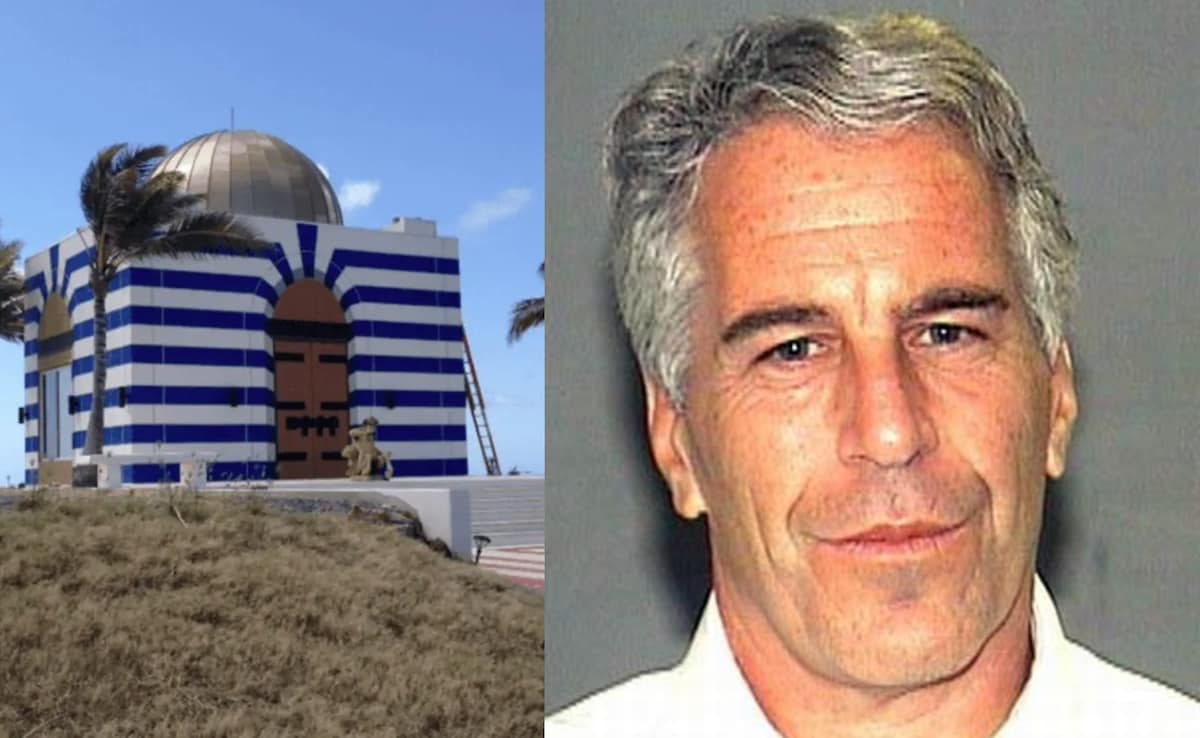
The late US sex offender Jeffrey Epstein made connections across the Middle East to nurture two of his hobbies. The first is popular, which was to build a well-connected, high-profile circle. The second was to hoard rare Islamic artefacts to adorn an unconventional building on his private island, according to a report by the New York Times.
The pieces were eclectic. From tapestries embroidered with Quranic verses that were shipped from Kaaba in Mecca to tiles from a mosque in Uzbekistan. A golden metal dome was built to mimic ancient Syrian architecture.
Through his connections that Epstein had even in the royal court of Saudi Arabia, he secured a meeting with the now Saudi crown prince Mohammed bin Salman. He got access to tapestries that were used inside and as exterior coverings for the Kaaba.
The records released by the Justice Department in January revealed the ways in which Epstein wanted to expand his network and his art collection.
Epstein was “obsessed” with decorating a strange blue-and-white-striped building with a golden dome on Little Saint James. It has been described as a music room, a pavilion, a chapel and even an occult temple. However, to Epstein, who was a secular Jew, it was a “mosque”.
Epstein’s “Mosque”
Epstein had told Vanity Fair in 2003 that he had “the largest Persian rug you’ll ever see in a private home – so big, it must have come from a mosque.”
According to the New York Times, correspondence between Epstein and his associates over many years showed that he hired architects to design a “hammam”, which is a Turkish bathhouse surrounded by “Islamic gardening”.
Soon after, he scrapped that plan and decided to build a “music room” in a building he called 5 Palms. He emailed himself the design ideas and images of ancient Middle Eastern mosques.
While speaking to a contact in Uzbekistan for tiles, he had said, “It will be for the inside walls, like a mosque.”
Ion Nicola, a Romanian artist who was hired for the project, said that Epstein called the building a “mosque”. He had asked for a design that would replace the Arabic word for God with his initials in English.
“Remember we saw the aribic writing in black and white,” he wrote in an email to Nicola, “instead of allah, i thought j’s and e ‘s.”
How Epstein Made His ‘Mosque Obsession’ A Reality
Around 2010, Jeffrey Epstein developed a close association with Terje Rod-Larsen, a Norwegian diplomat who would later play a role in advancing both his business pursuits and his plan to build a mosque. Records indicate the two men were in regular contact, discussing everything from commercial ventures to global affairs and personal matters.
Saudi Arabia featured prominently in their exchanges, with discussions intensifying in 2016. At the time, Mohammed bin Salman, then serving as deputy crown prince, was exploring plans to list the state oil giant Saudi Aramco. Epstein sought to position himself as a financial adviser in that effort.
Rod-Larsen introduced Epstein to Raafat Al-Sabbagh, a consultant to the Saudi royal court, along with his associate Aziza Al Ahmadi. Through these connections, Epstein actively pursued an audience with the prince. He met them in New York and pushed for a direct pitch, sharing what he described in one message as “radical ideas”, including the creation of a new currency called “the shariah” for use among Muslims.
Plans for a visit soon followed. Al Ahmadi directed Epstein to the Saudi consulate, instructing him to say “that you, Jeffrey Epstein, has an invitation from His Royal Highness: PRINCE mohammed bin salman.”
After arriving in the kingdom, Epstein sent Rod-Larsen two photos of himself in a light-hearted moment with Mohammed, one of which he later displayed at his New York residence.
“Pieces From Kaaba”
In early 2017, Epstein and Al Ahmadi met again in New York while their aides coordinated shipments from Saudi Arabia to his private island. Among the items discussed was a tent, with more objects said to be on the way “for the mosque”.
“We are receiving 3 pieces from the Kaaba,” Epstein’s assistant told a customs broker.
Documents referenced embroidered textiles tied to the Kaaba. One piece had reportedly been “used inside the Kaaba”, another was identified as a Kiswa, the cloth that covers the structure, and a third was said to originate from a specialised factory in Mecca.
The Kiswa carries deep religious meaning. Each year, a new covering is produced by hundreds of artisans using vast quantities of silk along with gold and silver thread. Once replaced, the cloth is cut into sections, which may be gifted, donated, or auctioned for charitable causes.
Al Ahmadi emphasised the spiritual weight of the items in an email to Epstein, “The black piece was touched by minimum 10 million Muslims of different denominations, Sunni, Shia and others,” she wrote. “They walk around the Kaaba seven rounds then every one tries as much as they can to touch it and they kept their prayers, wishes, tears and hopes on this piece. Hoping after that all their prayers to be accepted.”
“Dark Clouds”
In 2017, Hurricane Maria caused widespread destruction across the Caribbean, including damage to Epstein’s island. Records suggest that parts of the so-called mosque were affected.
At the same time, other pressures were building. Mohammed bin Salman had become crown prince and appeared to distance himself from Epstein, a development that reportedly frustrated him. In a message to Rod-Larsen, Epstein wrote, “The kingdom needs lots of expensive help now as they did not follow the jew directions,” apparently referring to himself.
After journalist Jamal Khashoggi was killed inside the Saudi consulate in Istanbul in October 2018, Epstein raised the issue with Rod-Larsen, referencing allegations that the crown prince had ordered the operation. Mohammed has denied authorising the killing, though he has acknowledged responsibility as Saudi Arabia’s leader at the time.
“Dark cloud over his head,” the diplomat responded. “And it won’t go away.”
A few weeks later, Epstein was arrested in July 2019 on fresh charges. He transferred ownership of his island to a private trust the following month. Two days later, Epstein was found dead in a federal jail in Manhattan.