
As Timber Disappear, Constructions Rise, Abuja Residents Rely Price Of Speedy Urbanisation

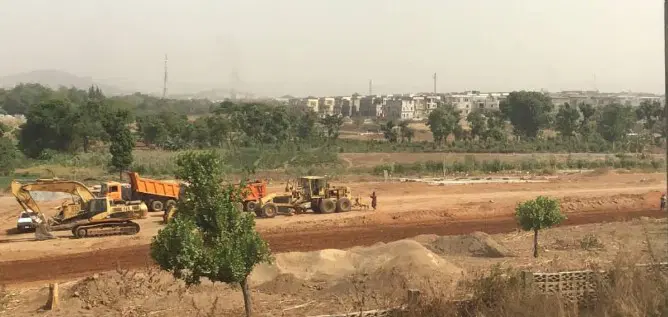
As soon as celebrated for its rolling hills, protecting inexperienced belts and punctiliously mapped grasp plan, Abuja is quick shedding its pure defend to relentless city growth.
Throughout the Federal Capital Territory, chainsaws hum the place timber as soon as stood, and bulldozers carve by way of forests that after cooled the town and absorbed its floods.
However past the rising skylines and luxurious estates lies a extra troubling actuality: as inexperienced cowl disappears, temperatures climb, floodwaters surge sooner, and local weather dangers intensify. What was as soon as a present from nature, has not been sapped by man in his quest to construct extra constructions for pecuniary good points. Thus, with extra homes arising right here and there, fetching hundreds of thousands for his or her homeowners, Abuja is step by step being become a scorched earth and rendered naked by builders. The impact comes again to harm each metropolis dweller.
When Abuja was chosen as Nigeria’s capital in 1976, it wasn’t only a political determination — it was a daring imaginative and prescient. Planners imagined a metropolis that may rise in concord with nature: rolling hills, lush forests, and huge inexperienced belts that may defend residents from the tough African solar and unpredictable rains. Each road, park, and property was mapped with a watch towards stability — a capital that may breathe, not simply operate.
Architects and concrete planners dubbed it a “inexperienced metropolis,” a logo of modernity intertwined with ecology. Protected forests and buffer zones have been intentionally built-in into the grasp plan, meant to soak up floodwaters, reasonable temperature, and maintain biodiversity. Abuja was meant to be greater than concrete and metal; it was meant to be a residing metropolis, the place nature and improvement coexisted.
In the present day, that imaginative and prescient is beneath siege as speedy inhabitants progress, sprawling estates, and unrelenting building are erasing the very inexperienced areas that have been meant to outline the capital. The dream of a climate-resilient Abuja is fading, changed by warmth, mud, and the creeping threat of floods — a stark warning that Africa’s showpiece metropolis could also be paying the worth for unchecked city ambition.
From the air, the adjustments are plain. Satellite tv for pc pictures present forested hills round Gwarimpa, Kubwa, and Jabi shrinking 12 months by 12 months, changed by sprawling housing estates, highways, and business complexes. The place as soon as thick greenery cushioned the town towards warmth and floods, now naked patches of land and dusty roads dominate the panorama.
Even on the bottom, the transformation is stark. Hills that used to rise in lush cowl at the moment are scarred with the marks of bulldozers, whereas luxurious estates and gated communities mushroom in beforehand protected zones. Residents on the outskirts of Lokogoma and Dutse-Alhaji report that streams have dried up or overflowed after rains, a direct consequence of misplaced forest buffers.
Satellite tv for pc knowledge compiled over the previous decade reveals a transparent development: between 2010 and 2023, forest cowl within the Federal Capital Territory declined by no less than 15–20%, with some previously dense patches virtually completely erased.
The inexperienced belts as soon as protected by Abuja’s grasp plan are more and more dotted with concrete, signaling a metropolis racing forward with improvement — and leaving its surroundings behind.
Abuja’s speedy growth is fueled by numbers that hold climbing. Within the Eighties, the town was house to just some hundred thousand folks; immediately, estimates place the inhabitants at over 3.6 million, with hundreds extra arriving each month searching for jobs, training, and higher residing requirements. The inflow has remodeled the capital from a deliberate, orderly metropolis right into a sprawling city panorama.
Each new resident means extra houses, extra roads, and extra demand for business and social infrastructure. Neighborhoods like Gwagwalada, Kubwa, and Jabi have mushroomed into dense settlements virtually in a single day, with forested areas cleared to make method for housing estates, markets, and highways. The inexperienced buffers as soon as defending the town from flooding and excessive warmth are vanishing beneath relentless city sprawl.
Abuja’s inhabitants growth has ignited an actual property frenzy, reworking the town’s panorama virtually in a single day. From the outskirts of Lokogoma and Lugbe to the scenic hills of Gwarimpa and Jabi, forests are being cleared at breakneck pace to make method for gated estates, luxurious flats, and sprawling residential complexes.
Personal builders are capitalizing on hovering demand, advertising “dream houses” to a rising center class whereas inexperienced areas vanish within the course of. For each property that rises, hills are flattened, timber uprooted, and wetlands drained — once-natural buffers towards warmth and flooding now diminished to concrete foundations.
The proliferation of estates has additionally pushed casual settlements deeper into remaining forest zones, making a cycle of deforestation that’s tough to regulate.
In Abuja, each new highway appears to return with a disappearing forest, from the busy Airport Highway expansions to new expressways linking Gwarimpa, Kubwa, and Bwari, hills are being flattened, streams diverted, and timber uprooted to pave method for asphalt and concrete.
Infrastructure initiatives, hailed as indicators of modernity, are silently carving by way of the town’s inexperienced belts. Giant-scale initiatives just like the Abuja-Kaduna expressway improve and ongoing city ring roads minimize throughout beforehand protected areas, displacing vegetation and altering pure water circulate. Bridges, drainage channels, and utility corridors usually observe the trail of least resistance — which more and more means clearing forests somewhat than conserving them.
The scars of deforestation and relentless city growth are now not summary warnings — they’re unfolding in actual time throughout the town. Summers are hotter, rains are heavier, and flooding has change into a recurring nightmare for residents residing close to cleared forests and dried-up streams.
Flooding, as soon as confined to low-lying areas, now strikes unexpectedly throughout elements of Gwagwalada, Kubwa, and Lokogoma, washing away roads, eroding soil, and damaging houses. Specialists warn that the town’s drainage programs — designed with forested catchments in thoughts — can now not deal with the amount of runoff from cleared hills and impermeable surfaces.
Biodiversity, too, is beneath siege as birds, monkeys, and different wildlife that after thrived in Abuja’s inexperienced belts are disappearing as forests vanish, and streams that supported fish and amphibians are drying or turning into polluted.
Knowledge from environmental monitoring reveals that common temperatures within the FCT have risen by 1.2°C over the previous decade, a development linked on to the lack of timber and inexperienced cowl. With out forests to offer shade and funky the air, neighborhoods are experiencing the city warmth island impact in full drive, with afternoon temperatures noticeably greater than only a decade in the past.
Equally, geospatial research of the town reveal a big drop in forestland from about 4,059/ km² in 1987 to 2,265/ km² by 2021, signalling speedy deforestation linked with city growth. Analysis additionally signifies that the FCT skilled a roughly 61/ % discount in closed and open cover vegetation between 1987 and 2014, underscoring how city progress has eaten into former inexperienced areas.
On the nationwide degree, Nigeria continues to lose about 400,000 hectares of forest annually because of deforestation from logging, agriculture and urbanisation — one of many highest charges globally.
Comparatively, Abuja’s 61% discount in cover vegetation between 1987 and 2014 locations it among the many quickest green-cover declining capitals in Africa. Whereas inhabitants progress in Abuja mirrors Nairobi or Addis Ababa, its speedy property proliferation and aggressive infrastructure initiatives are intensifying local weather vulnerability extra sharply than in another capitals.
For a lot of residents of the town, circumstances of flooding, warmth waves and different environmental situations have change into the order of the day, In Kubwa, flash floods have change into routine after heavy rains. Roads are washed out, houses partially submerged, and residents battle to navigate streets that have been as soon as satisfactory.
Within the 2022 wet season alone, widespread flooding struck giant elements of the town affecting about 24,713 residents throughout a number of space councils, together with Abuja Municipal Space Council, AMAC, Bwari, and Abaji.
1000’s have been displaced, houses and infrastructure have been broken, and full neighbourhoods, from Efab, Lokogoma and Lugbe to main expressways, skilled inundation because of heavy rains and overwhelmed drainage programs. A complete of 131 constructions have been reported broken within the metropolis alone throughout that season.
Flash flooding in 2025 additionally paralysed elements of the town, with areas resembling Asokoro, Guzape, Jabi, Kado and Wuse submerged and roads rendered impassable by knee deep waters throughout intense downpours — underscoring how recurrent and extreme city flooding has change into.
These occasions are a part of a wider sample of accelerating flood threat in and round Abuja throughout the wet season, pushed by heavier rainfall, blocked drainage and the lack of pure flood absorbing landscapes.
Past the increasing estates and rising skyscrapers, Abuja’s rural outskirts inform a unique story — certainly one of hardship, shrinking farmlands, and a altering local weather that threatens livelihoods.
For generations, farmers in Gwagwalada, Kwali, and Bwari cultivated crops on fertile land shaded by timber and sustained by seasonal rains. However as forest cowl is cleared for city improvement, these pure programs are being disrupted. Timber that after protected crops from harsh solar and helped retain soil moisture are gone, exposing fields to intense warmth and sooner evaporation.
The lack of vegetation additionally accelerates soil erosion. With fewer roots to carry topsoil in place, rains wash away fertile earth, decreasing yields and forcing farmers to clear much more land searching for productive soil — a cycle that additional chips away on the remaining inexperienced belt.
For these farmers, deforestation isn’t simply an environmental statistic — it interprets into misplaced earnings, meals insecurity, and a rising worry that their lifestyle is being buried beneath concrete and local weather change alike.
Abuja is not only going through the impacts of local weather change and deforestation; Nigeria has formally joined the worldwide struggle towards it. As a signatory to the Paris Bargain, the nation has submitted successive Nationally Decided Contributions, NDCs, outlining the way it plans to chop greenhouse fuel emissions and adapt to local weather dangers, together with deforestation and land-use change.
Beneath its newest NDC/ 3.0, Nigeria has pledged to scale back emissions by round 29% by 2030 and 32% by 2035 in contrast with enterprise as common eventualities, whereas setting a pathway to internet zero emissions by 2060. The plan additionally particularly targets land use and forestry — aiming to scale back deforestation by about 60% and plant hundreds of thousands of timber yearly as a part of its local weather response.
Sponsored
This dedication displays Nigeria’s recognition that land and forests are local weather belongings, not simply {economic} sources — and that defending them is central to assembly its Paris objectives.
Towards this backdrop, the deforestation and land clearing pushed by speedy urbanisation in Abuja tackle added significance: they aren’t merely native improvement points, however obstacles to Nigeria’s potential to ship on its worldwide local weather obligations and shield its folks from worsening warmth, floods, and different local weather impacts.
Abuja’s speedy growth has sparked a heated debate amongst planners, environmentalists, and policymakers: can the town develop with out sacrificing its local weather resilience? Proponents of aggressive city improvement argue that constructing new estates, roads, and business hubs is important to satisfy the wants of a booming inhabitants. They level to the {economic} advantages, improved infrastructure, and elevated housing availability.
Environmental specialists, realtors, regulator react
A realtor, Anyebe Victor, argued that urbanisation is the treatment, not the illness.
Whereas critics lament the sight of fallen timber in rising districts such as Wuye and Guzape, Victor stated the actual environmental hazard laid past the town’s vivid lights, in unplanned sprawl creeping throughout the outskirts of the Federal Capital Territory.
In line with him, halting high-density improvement in central districts wouldn’t cease inhabitants progress. As an alternative, it could push hundreds of residents outward into satellite tv for pc communities such as Gwagwalada and Kwali Space Council, the place low-density housing may eat huge stretches of forest land.
“It’s higher to accommodate 50,000 folks inside 100 hectares within the metropolis than to clear 5,000 hectares within the rural councils for scattered bungalows,” he maintains.
Victor additionally hyperlinks urbanization to cleaner power use. In lots of rural FCT communities, firewood stays a major cooking gas, a observe that fuels deforestation. Transferring households into estates related to fuel and electrical energy, he says, reduces dependence on charcoal and wooden.
For Victor, the higher threat to Abuja’s ecosystem is poverty-driven, unregulated land use, not cranes on building websites. “Sensible improvement is the perfect conservation technique we have now,” he insists.
A coverage professional and environmentalist, Jeremiah Ato, additionally raised alarm over the rising temperature ranges within the Federal Capital Territory, FCT, warning that Abuja would possibly change into unlivable throughout the subsequent 20 years if pressing environmental reforms weren’t carried out.
Ato confused the necessity for sustainable improvement practices, noting that speedy urbanisation within the nation’s capital had considerably diminished inexperienced areas and vegetative cowl.
In line with him, whereas infrastructural progress is critical, it have to be balanced with environmental issues, particularly within the face of worsening local weather change.
“It’s not nearly increasing the constructed surroundings. We should be certain that as we develop, we additionally protect nature by sustaining enough vegetative cowl and planting timber throughout the town,’’ he stated.
Ato lamented that Abuja, as soon as recognized for its tree-lined streets, has witnessed a gentle disappearance of greenery, significantly within the metropolis centre, the place pavements and concrete constructions now dominate the panorama.
He known as on the Federal Capital Territory Administration, FCTA, to urgently overview its improvement insurance policies and introduce legal guidelines that may make tree planting necessary in all estates and building initiatives throughout the metropolis.
“There’s a want for an enabling legislation that compels builders to combine tree planting into their initiatives. That is now not non-obligatory — it’s obligatory for our survival,” he stated.
He nevertheless urged each FCT authorities and residents to behave swiftly, warning that delay may have long-term penalties for the town’s local weather, public well being, and general livability.
The Venture Officer on Local weather Change on the Centre for Journalism Innovation and Growth, CJID, Nicholas Adeniyi, additionally warned that unchecked city growth and weak coverage enforcement have been eroding the town’s authentic grasp plan.
Adeniyi famous that Abuja was developed with built-in city improvement with agroforestry, making certain a stability amongst housing, agriculture and forest conservation.
He defined that older districts such as Asokoro nonetheless mirrored this imaginative and prescient, with plentiful timber and inexperienced areas embedded inside residential layouts. Nonetheless, he lamented that newer districts and satellite tv for pc cities now not adopted this sample.
On methods to strike a stability between city growth and environmental conservation, Adeniyi emphasised the necessity for deliberate planning and strict adherence to zoning legal guidelines. He advocated the safety of ecological corridors linking forest reserves to city areas, noting that such programs supported biodiversity and enhanced city resilience.
He advisable insurance policies that mandate tree alternative, suggesting that builders must be required to plant a number of timber for each one eliminated. Past laws, he confused the necessity for public consciousness and cultural reorientation towards environmental stewardship.
We’re taking steps to implement environmental guidelines — NESREA
For all the problems raised for and towards Abuja urbanisation, the Nationwide Environmental Requirements and Regulatory Enforcement Company, NESREA, stated it was working assiduously to keep up the wanted security of the town because the inhabitants continued to develop and extra folks required lodging.
The NESREA Director Environmental High quality Management, Mr. Elijah Udofia, stated the company was strengthening enforcement of environmental legal guidelines to sort out rising deforestation, linked to speedy urbanisation within the Federal Capital Territory, FCT.
Udofia defined that the company operates inside a strong authorized framework designed to safeguard forest ecosystems, even as improvement pressures intensify in Abuja.
On the safety of forested areas throughout the FCT, Udofia disclosed that, past federal laws, efforts have been underway to strengthen native frameworks.
He revealed that the Sustainable Forest Administration Coverage and Implementation Plan, alongside the Forestry Act for the FCT, had been reviewed and awaiting last gazetting to assist in implementing guidelines on the surroundings and associated issues.
Udofia warned that unchecked deforestation, pushed by city growth, posed severe environmental dangers, together with biodiversity loss, erratic climate patterns, water shortage, air air pollution, soil erosion and elevated flooding.
On whether or not the company has carried out research on the impression of urbanisation on carbon sequestration and air high quality, he stated such research have been but to be undertaken.
The NESREA director highlighted collaboration with the Federal Capital Growth Authority, FCDA, as a key technique in balancing improvement with environmental safety, including that the partnership ensured strict adherence to Environmental Affect Evaluation, EIA, necessities for all improvement initiatives within the territory.
He urged residents to play an lively position by reporting circumstances of unlawful deforestation by way of the company’s official criticism channels, together with its web site, places of work and enforcement hotlines.
Trying forward, he affirmed that NESREA remained dedicated to selling sustainable improvement by way of strict enforcement of environmental laws and continued strengthening of coverage frameworks.
However it stays to be seen what number of timber will nonetheless stay to offer consolation for FCT residents as extra monumental constructions proceed to emerge on current and new districts within the capital metropolis of Nigeria.