

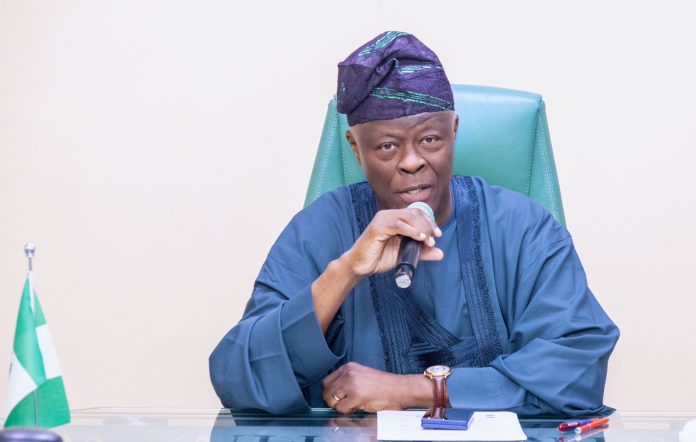
The Federal Authorities has stated Nigeria should regularly transfer away from heavy borrowing and as a substitute strengthen its potential to generate income domestically to realize long-term {economic} stability.
Minister of Finance and Coordinating Minister of the Economic system, Wale Edun, made the decision on Tuesday in the course of the administration retreat of the Nigerian Income Service in Abuja, the place he warned that elevating funds by means of debt has turn into more and more tough for creating nations.
He famous that the worldwide {financial} local weather is tightening, with worldwide cooperation weakening and plenty of international locations turning inward, leaving poorer economies with fewer funding choices.
“And naturally, we have to scale back our dependence on debt. And so, income mobilisation inside this context is a developmental crucial,” Edun stated.
In line with him, the retreat from multilateral assist has created an imbalance for creating international locations, which now spend extra on servicing debt than they obtain from international help or investments.
Citing latest figures, Edun stated creating nations collectively paid about $163bn in debt service in 2024, in contrast with $42bn in abroad growth help and $97bn in international direct funding.
He defined that such tendencies present why Nigeria should concentrate on strengthening home earnings sources reasonably than counting on exterior loans, significantly amid rising world rates of interest.
“The first anchor of our fiscal sustainability… goes to be our personal fiscal efforts, our personal potential to generate financial savings, which then can be utilized for funding,” Edun stated. “And earlier than you possibly can generate financial savings, it’s a must to have the income.”
He added that shocks such because the COVID-19 pandemic, geopolitical tensions and commerce disputes have pressured many creating economies to borrow extra whereas going through larger reimbursement prices, squeezing public funds and limiting funds for fundamental companies.
“That’s the reason it’s vital right now that we transfer to an period of sustainable revenues in order that we will make investments meaningfully in infrastructure, strengthen schooling and healthcare, and assist the poorest and probably the most susceptible,” Edun stated.
Regardless of the minister’s push for decreased borrowing, the Nationwide Meeting has indicated that new loans should be crucial to handle funding shortfalls.
Talking at a public listening to on the 2026 Appropriation Invoice, Chairman of the Senate Committee on Appropriations, Olamilekan Adeola, stated borrowing stays tough to keep away from given the nation’s weak income profile and huge growth wants.
“Nigeria can not assist however maintain borrowing as a result of income inflows are unpredictable and growth wants are monumental. What issues is how we borrow and the way we fund our deficits,’’ Adeola stated.
Edun described ongoing tax reforms as central to authorities efforts to spice up collections, enhance equity and make the system extra environment friendly. Nevertheless, he burdened that coverage adjustments alone wouldn’t ship outcomes with out higher compliance and correct implementation.
“No fiscal reform can ship outcomes if compliance is weak or uneven,” he stated. “But compliance can’t be achieved by means of enforcement alone. It’s carrot and stick.”
He stated constructing belief between taxpayers and authorities establishments was vital, noting that residents are extra prepared to conform after they see tangible returns from their contributions.
“Folks should see the advantages of their contributions in infrastructure and in companies,” he stated.
Edun additional emphasised the strategic function of the Nigerian Income Service in driving the broader fiscal reform agenda, saying the company should translate insurance policies into measurable enhancements. He added that stronger and extra predictable income flows would assist scale back {economic} vulnerability and enhance service supply nationwide.
“The connection between macroeconomic situations and income efficiency is direct and unavoidable,” he stated. “{Economic} progress expands the tax base. Change price dynamics have an effect on customs income. Inflation influences compliance behaviour and impacts the actual worth of collections.”
He additionally warned in opposition to overreliance on risky oil earnings, urging the event of a extra steady income construction that may face up to fluctuations in world markets.