

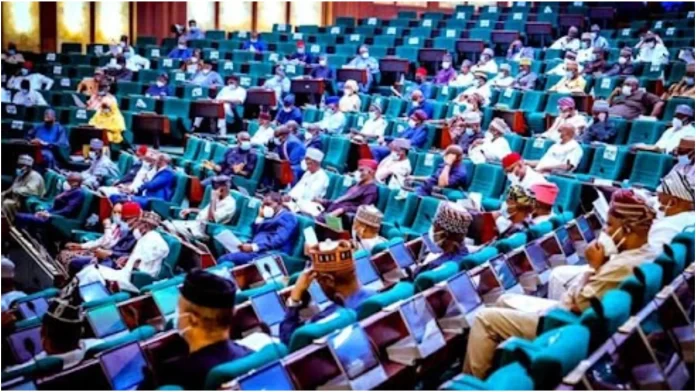
The federal authorities’s N58.47 trillion 2026 appropriation invoice has handed the second studying on the home of representatives.
The cash invoice scaled second studying throughout Thursday’s plenary after the home reconvened from over half-hour of govt session.
Julius Ihonvbere, lawmaker representing Owan federal constituency and the bulk chief, moved a movement for the consideration of the finances.
Presenting the invoice’s basic ideas, Ihonvbere described the finances as a part of a protracted and tough journey in the direction of peace, development, stability, and sustainable growth.
He mentioned true growth should be sustainable, noting that non permanent progress doesn’t quantity to actual growth.
The bulk chief mentioned {economic} development is commonly difficult and painful, particularly in a rustic that inherited distorted political, social, and {economic} constructions.
The lawmaker mentioned the duty of restructuring and repositioning Nigeria would by no means be painless.
Ihonvbere mentioned the present administration didn’t inherit a brand new set of residents however was working with the identical Nigerians and establishments formed by earlier administrations.
The rating legislator urged lawmakers to place themselves within the place of these managing the economic system, emphasising that the nationwide meeting had a accountability to information the manager and guarantee accountability.
He highlighted the president’s international engagements, together with a current go to to Turkey, which he described as a powerful {economic} associate.
The lawmaker mentioned the naira had remained comparatively secure, noting that the change fee had fallen from over N1,800 to about N1,400, including that President Bola Tinubu had not printed cash since assuming workplace.
The lawmaker mentioned Nigeria’s exterior reserves had risen to about $46 billion, sufficient to cowl greater than 10 months of imports, noting that these indicators fashioned the background to the 2026 finances.
Ihonvbere outlined the administration’s commitments, together with improved finances self-discipline, stronger income efficiency, higher tax administration, blockage {of financial} leakages, consolidation of macroeconomic stability, enchancment of the enterprise surroundings, human capital growth, and efficient debt administration.
He mentioned each the manager and the legislature have been dedicated to implementing these objectives within the curiosity of Nigerians.
Ihonvbere described the finances as an announcement of guarantees, expectations, and the federal government’s imaginative and prescient, reflecting a dedication to constructing a social, political, {economic}, and cultural surroundings that permits Nigerians to achieve their full potential.
He mentioned such progress would profit future generations and encourage successive governments to construct on present achievements, whereas prioritising the welfare and safety of girls and kids.
The lawmaker urged his colleagues to assist the finances and hold hope alive, stressing that the legislature was a part of the federal government and had a task to play in making certain its success.
Following Ihonvbere’s presentation, Tajudeen Abbas, speaker of the home, referred to as for a voice vote, with the “ayes” outweighing the “nays.”
The home subsequently handed the invoice for second studying with none debate or opposition.
Tinubu offered the 2026 finances to the joint session of the nationwide meeting on December 19.
The senate handed the finances for second studying on December 23.
THE BUDGET BREAKDOWN
A breakdown of the finances exhibits that out of the overall N58,472,628,944,759 finances, N4,097,381,103,856 is earmarked for statutory transfers and N15,909,361,631,657 for debt servicing.
The finances proposes N15,251,538,827,423 for recurrent (non-debt) expenditure, which incorporates the routine working prices of presidency.
As well as, the appropriation invoice allocates N23,214,347,381,824 to the event fund for capital expenditure, meant to finance infrastructure and different long-term initiatives.
On December 18, the home handed the 2026-2028 medium-term expenditure framework (MTEF) and the fiscal technique paper (FSP).
The inexperienced chamber endorsed the federal authorities’s projected crude oil benchmark costs of $64.85, $64.3, and $65.5 per barrel for 2026, 2027, and 2028, respectively.
Nonetheless, the senate accepted a downward overview of the crude oil benchmark value for 2026 to $60 per barrel, from $64.85
The decrease legislative chamber retained the projected home crude oil production of 1.84 million barrels per day (mbpd), 1.88 mbpd, and 1.92 mbpd for 2026, 2027, and 2028, respectively.
The home additionally accepted a projected change fee of N1,512, N1,432.15, and N1,383.18 for the 2026-2028 fiscal yr.
On inflation fee projections for 2026, 2027, and 2028, the legislators adopted 16.5 p.c, 13 p.c, and 9 p.c, respectively.
In anticipation of tax reform features, the home additionally accepted GDP development fee projections of 4.68 p.c, 5.96 p.c and seven.9 p.c for the years 2026, 2027, and 2028, respectively.